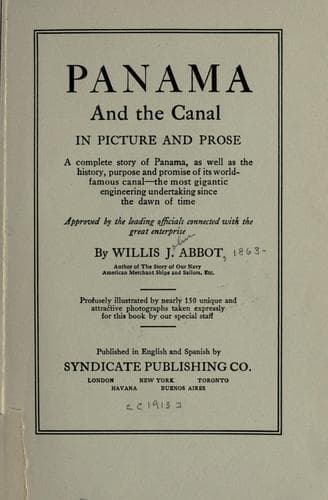
Panama and the Canal in Picture and ProseAbbot, Willis J. (Willis John)
History
Panama and the Canal in Picture and Prose
Abbot, Willis J. (Willis John)
Panama Canal (Panama) -- History
Nobody could return from the Zone without a desire to express thanks for
the hospitalities shown him and the author is fortunate in possessing
the opportunity to do so publicly. Particularly do I wish to acknowledge
indebtedness or aid in the preparation of this book to Col. George W.
Goethals, Chairman and Engineer in Chief, and to Col. W. C. Gorgas,
Commissioner and Chief Sanitary Officer. It goes without saying that
without the friendly aid and coöperation of Col. Goethals no adequate
description of the canal work and the life of the workers could ever be
written. To the then Secretary of War, Hon. Henry L. Stimson, under
whose able administration of the Department of War much of the canal
progress noted in this book was made, the author is indebted for
personal and official introductions, and to Hon. John Barrett, one time
United States Minister to Colombia and now Director General of the Pan
American Union, much is owed for advice and suggestion from a mind
richly stored with Latin-American facts.
On the Canal Zone Hon. Joseph B. Bishop, Secretary of the Isthmian Canal
Commission, Hon. Maurice H. Thatcher, Civil Governor, and Mr. H. H.
Rousseau, the naval member of the Commission, were particularly helpful.
Thanks are cordially extended to Prof. F. A. Gause, the superintendent
of schools, who has built up on the Canal Zone an educational system
that cannot fail to affect favorably the schools of the surrounding
Republic of Panama; to Mr. Walter J. Beyer, the engineer in charge of
lighthouse construction, and to Mr. A. B. Dickson who, by his active and
devoted work in the development of the Y. M. C. A. clubs on the Zone,
has created a feature of its social life which is absolutely
indispensable.
The illustration of a book of this nature would be far from complete
were the work of professional photographers alone relied upon. Of the
army of amateurs who have kindly contributed to its pages I wish to
thank Prof. H. Pittier of the Department of Agriculture, Prof. Otto
Lutz, Department of Natural Science, Panama National Institute; Mr. W.
Ryall Burtis, of Freehold, N. J.; Mr. Stewart Hancock Elliott, of
Norwalk, Conn.; Mr. A. W. French, and Dr. A. J. Orenstein of the
Department of Sanitation.
The opening of the Panama Canal does not merely portend a new era in
trade, or the end of the epoch of trial and struggle on the Isthmus. It
has a finality such as have few of the great works of man. Nowhere on
this globe are there left two continents to be severed; two oceans to be
united. Canals are yet to be dug, arms of the sea brought together. We
may yet see inland channels from Boston to Galveston, and from Chicago
to New York navigable by large steamships. But the union of the
Mediterranean and the Red Sea at Suez, and the Atlantic and Pacific at
Panama stand as man’s crowning achievements in remodeling God’s world.
As Ambassador James Bryce, speaking of the Panama Canal, put it, “It is
the greatest liberty Man has ever taken with Nature.”
Public-domain text, read in full here on John Shaqi.
Reviews
Reviews
No reviews yet
Be the first to share your thoughts on this work.
Join the Discussion
Join the discussion
Sign in to leave a comment or review.
Sign InorCreate an account