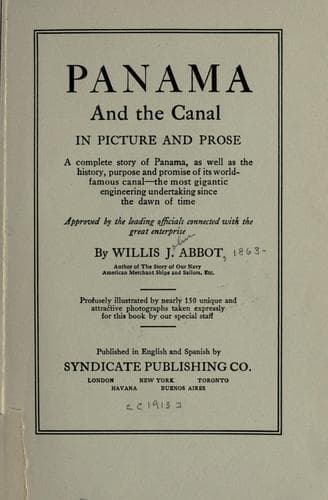
Panama and the Canal in Picture and ProseAbbot, Willis J. (Willis John)
History
Panama and the Canal in Picture and Prose
Abbot, Willis J. (Willis John)
Panama Canal (Panama) -- History
[Illustration: RUINS OF OLD PANAMA]
CHAPTER I
THE FRONT DOOR TO PANAMA
The gray sun of a bitter February day was sinking in a swirling sea as
the ship doggedly plowed its way southward along the New Jersey coast.
One after another the beacons that guard that perilous strip of sand
twinkled out, and one after another voyagers unused to ocean’s stormiest
moods silently disappeared into secretive cabins. “It may be a stern and
rockbound coast,” said one lady with poetic reminiscence, “but I wish I
was on it!” For it must be set down as a melancholy truth that the
voyage from New York to Colon is as a rule tempestuous.
Most who seek the Canal Zone as mere sightseers will choose winter for
the trip, at which time wintry gales are the rule as far south as the
Bahamas--after which the long smooth rollers of the tropical ocean will
sufficiently try the unaccustomed stomach even though the breezes which
accompany them be as mild as those of Araby the blest. In brief, to
reach in winter our newest possession you must brave the ordinary
discomforts of a rough voyage, and three days of biting cold weather as
well, unless you sail from New Orleans, or the terminus of Mr. Flagler’s
new over-sea railroad at Key West.
Despite its isthmian character, the Canal Zone, Uncle Sam’s most
southerly outpost, may be called an island, for the travelers’ purpose.
True it is bordered on but two sides by water, and thus far violates the
definition of an island. But it is only to be reached by water. The
other two sides are walled in by the tangled jungle where vegetation
grows so rank and lush that animal life is stunted and beaten in the
struggle for existence by the towering palms, clustering ferns and
creeping vines. Only things that crawl on their bellies like the serpent
accursed in Eden grow to their fullest estate in this network of
rustling green. Lions there are, by the talk of the natives at least,
but when you encounter them they turn out to be mere stunted specimens
of our northern wild cat. The deer, rarely met, are dwarfed but are the
largest animals to be found in the jungle, though one hears reports of
giant boas. Indeed the remnants of the age of reptiles are large to our
eyes, though puny in comparison with the giants that scientists
christened, long centuries after they were extinct and unable to
protest, with such names as ichthyosaurus. You will still find lizards
or iguana, three to five feet long, if your search of the jungle be
thorough. The tapir, or ant eater, too, grows to huge size. But it is
not dread of wild animals that keeps man from penetrating the jungle.
The swift growing and impenetrable vegetation blocks the paths as fast
as cut, and he who would seek the Canal Zone must follow the oldest of
highways, the sea.
[Illustration: TREE GROWING OUT OF A CHIMNEY IN JAMAICA]
Public-domain text, read in full here on John Shaqi.
Reviews
Reviews
No reviews yet
Be the first to share your thoughts on this work.
Join the Discussion
Join the discussion
Sign in to leave a comment or review.
Sign InorCreate an account