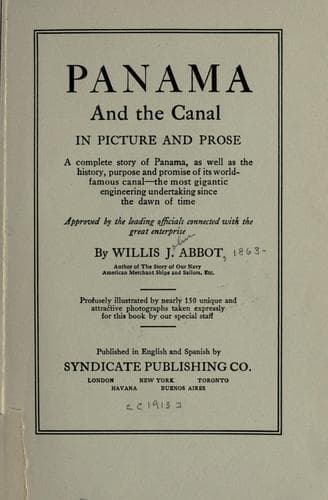
Panama and the Canal in Picture and ProseAbbot, Willis J. (Willis John)
History
Panama and the Canal in Picture and Prose
Abbot, Willis J. (Willis John)
Panama Canal (Panama) -- History
If New York be the port of departure, several lines offer themselves to
the traveler, and soon after the canal is opened their number will be
increased. At present the Panama Railroad Company, owned by the
government, maintains a line of ships mainly for the carriage of
supplies and employes of the Canal Commission. There is already
discussion of the wisdom of abandoning this line after the construction
work is over, on the ground that the United States government has no
right to enter into the business of water transportation in competition
with private parties. If sold by the government, however, the line will
doubtless be maintained under private ownership. The United Fruit
Company, an American corporation with an impressive fleet of ships all
flying the British flag, also carries passengers to the Isthmus from New
York and New Orleans, as does the Hamburg-American Line, from New York
only. My own voyage was by the Royal Mail Steam Packet line, an historic
organization chartered in 1839 for the express purpose of bringing
England into closer touch with its West Indian colonies. The excellent
ships of this line, sailing fortnightly from New York, touch at the
little port of Antilla on the northern shore of Cuba, spend twenty-four
hours at Jamaica and reach Colon on the eighth day of the voyage. Thence
the ship plows along through our American Mediterranean, touching at
Trinidad, St. Kitts, Barbadoes and other British colonial outposts until
at last she turns into the open ocean, buffeting her way eastward to
Gibraltar and Southampton, her home port.
[Illustration: CANE RIVER FALLS]
A real bit of England afloat is the “Oruba” with officers clad on
festive occasions in full dress uniforms closely resembling those of the
Royal Navy, and stewards who never dropped dishes in a storm but dropped
their h’s on the slightest provocation. “’E’s in the ’old, mum,”
explained one when a lady inquired for the whereabouts of a missing dog.
It is wonderful after all how persistent are the British manners and
customs in the places the English frequent. From the breakfast tea,
bloaters and marmalade, to the fish knives sensibly served with that
course at dinner, but which finicky Americans abjure, all about the
table on these ships is typically English. In the colonies you find
drivers all turning to the left, things are done “directly” and not
“right away,” every villa has its tennis court, and Piccadilly, Bond
St., and Regent Street are never missing from the smallest colonial
towns.
Public-domain text, read in full here on John Shaqi.
Reviews
Reviews
No reviews yet
Be the first to share your thoughts on this work.
Join the Discussion
Join the discussion
Sign in to leave a comment or review.
Sign InorCreate an account