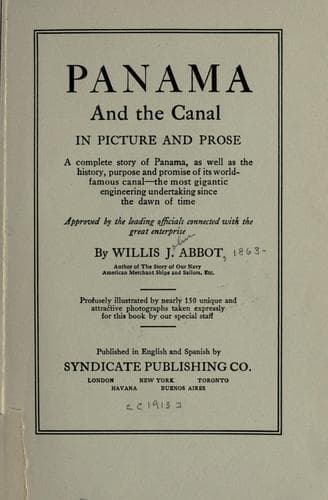
Panama and the Canal in Picture and ProseAbbot, Willis J. (Willis John)
History
Panama and the Canal in Picture and Prose
Abbot, Willis J. (Willis John)
Panama Canal (Panama) -- History
If the air is dusty, the prevailing complexion is dusky. For in this
island of about 850,000 people only about 15,000 are listed in the
census as “white,” and the whiteness of a good many of these is
admittedly tarnished by a “touch of the tarbrush.” As in every country
in which any social relation between the races is not remorselessly
tabooed--as it is in our southern states--the number of “colored” people
increases more rapidly than that of either black or white. There were in
1834, 15,000 whites out of the population of 371,000; there are today
15,605, but the blacks and mongrels have increased to more than 800,000.
The gradations in color in any street group run from the very palest
yellow to the blackest of Congo black. That is hardly the sort of
population which the United States desires to take to its bosom.
[Illustration: COALING TRANSATLANTIC STEAMSHIPS]
The Jamaica negro is a natural loafer. Of course he works when he must,
but betwixt the mild climate, the kindly fruits of the earth and the
industry of his wife or wives, that dire necessity is seldom forced upon
him. My first glimpse of industrial conditions in Jamaica was taken from
the deck of a ship warping into dock at Kingston. Another ship, lying at
the same dock, was being coaled. Down and up the 1000 feet or so of dock
tramped long files of indescribably ragged, black and dirty figures.
Those going down bore on their heads baskets piled high with coal, going
back they bore the baskets empty. Of the marching figures fully
two-thirds were women. With tattered skirts tucked up to the knees and
the merest semblance of waists, barefooted, they plodded along. The
baskets carried about 65 pounds of coal each, and for taking one from
the pile and emptying it into the ship’s bunkers these women received
half a cent. There was no merriment about the work, no singing as among
our negro roustabouts on the Mississippi. Silently with shoulders
squared, hands swinging in rhythm and basket poised firmly on the head,
the women strode along, working thus for perhaps eight or nine hours and
then flocking home chatting noisily as they darkened the streets and
forced the white-clad tourists to shrink aside from grimy contact. On
the country roads you find lines of women carrying fruit and vegetables
to market, but seldom a man. Yet thus far that weaker sex has not
developed a suffragette, although they support the colony.
There is much head work in Jamaica, even if there be little brain work.
The negroes carry everything on their heads. The only hat I saw on a
man’s kinky poll was an old derby, reversed, filled with yams and thus
borne steadily along. A negro given a letter to deliver will usually
seek a stone to weight it down, deposit it thus ballasted amidst his
wool and do the errand. In Panama an engineer told me of ordering a
group of Jamaicans to load a wheel-barrow with stones and take it to a
certain spot.
Public-domain text, read in full here on John Shaqi.
Reviews
Reviews
No reviews yet
Be the first to share your thoughts on this work.
Join the Discussion
Join the discussion
Sign in to leave a comment or review.
Sign InorCreate an account