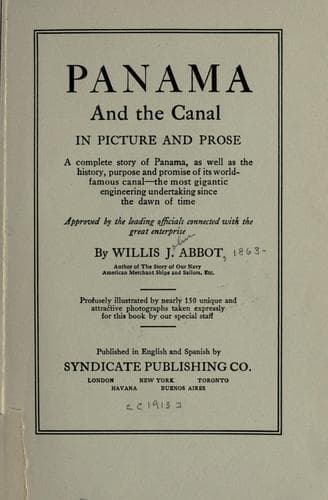
Panama and the Canal in Picture and ProseAbbot, Willis J. (Willis John)
History
Panama and the Canal in Picture and Prose
Abbot, Willis J. (Willis John)
Panama Canal (Panama) -- History
“Would you believe it,” he said, “when they had filled that
wheel-barrow, two of the niggers lifted it to their companion’s head,
balanced it and he walked off with it as contented as you please.”
The huts in which the negroes live are as a rule inconceivably small.
They are just a trifle larger than a billiard table, built of wattled
cane, and plastered over with clay. The roof is usually a thatch of
palm branches, though sometimes ragged strips of corrugated iron are
employed with much less artistic effect. In what corresponds to our
tenements, the rooming places of day laborers, the yard rather than the
house is the unit. So you will see on a tiny shack about the size of a
playhouse for children the sign, “Rooms for Rent,” which applies not to
the pigmy edifice bearing it, but to the cluster of huts set down helter
skelter in the yard. The people sleep in the huts, incidentally barring
them so far as the flimsy construction permits against any possible
entrance of fresh air. All the other activities of life are conducted in
the open--cooking, eating, sewing, gossiping. A yard is the most social
place imaginable, and the system not only contributes to health by
keeping people in the open air, adds to the gayety of life by grouping
so many black families in one corral, reduces the high cost of living as
our model tenements never can hope to, but makes one black landlord
independent, for the possession of a yard with its rooms all rented
leaves nothing needed for enjoyment except a phonograph and an ample
supply of the rum for which the island is famous.
[Illustration: MARKET WOMEN AND THEIR DONKEYS
The true industrial forces of Jamaica. Men are seldom seen as carriers
or sellers of produce]
Racially the Jamaica peasant is a negro, with varying admixtures of
white blood. The mongrel breed is steadily increasing and the pure white
population relatively decreasing. Economically the peasant is either a
day laborer or a servant, and as 40,000 are classed as servants in a
population where the employing class is limited, it follows that
employers keep many servants and the supply always exceeds the demand.
Children come rapidly to the Jamaicans. Marriage is easy and to dispense
with it easier still, so that 62 per cent of the births are
illegitimate. “My people are very religious,” said a missionary proudly,
“but, dear me, how immoral they are!”
Public-domain text, read in full here on John Shaqi.
Reviews
Reviews
No reviews yet
Be the first to share your thoughts on this work.
Join the Discussion
Join the discussion
Sign in to leave a comment or review.
Sign InorCreate an account