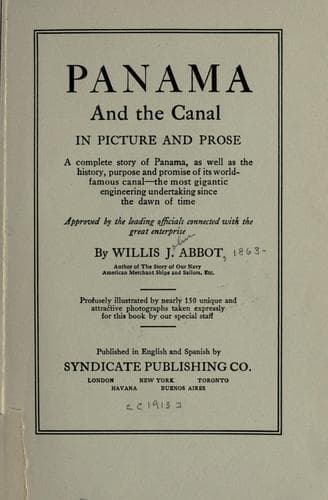
Panama and the Canal in Picture and ProseAbbot, Willis J. (Willis John)
History
Panama and the Canal in Picture and Prose
Abbot, Willis J. (Willis John)
Panama Canal (Panama) -- History
Let us for the time turn from the Panama of today, and from speculation
as to its future, and look back upon the Panama of the past. It is a
past too full of incident, too replete with stories of battle, murder
and sudden death for full justice to be done to it in a chapter.
Volumes, libraries almost, have been written about it, for Panama is not
one of the happy countries without a history. Of that history the survey
here is necessarily the most cursory.
[Illustration: MODERN PORTO BELLO PROM ACROSS THE BAY]
Twenty miles from Colon to the east is the spacious deep water harbor of
Porto Bello, visited and named by Columbus in 1502. Earlier still it had
harbored the ships of Roderigo de Bastides who landed there in
1500--probably the first European to touch Panama soil. He sought the
strait to the Indies, and gold as well. A few miles east and north of
Porto Bello is Nombre de Dios, one of the earliest Spanish settlements
but now a mere cluster of huts amidst which the Canal workers were only
recently dredging sand for use in construction. Few visit Nombre de Dios
for purposes of curiosity and indeed it is little worth visiting, for
fires, floods and the shifting sands of the rivers have obliterated all
trace of the old town. The native village consisted of about 200 huts
when the American invasion occurred, but a spark from one of the engines
set off the dry thatch of one of the huts and a general conflagration
ensued. The Americans have since repaired the damages, to the sanitary
advantage of the place, but at heavy cost to its picturesqueness.
[Illustration: TYPICAL NATIVE HUT IN PORTO BELLO DISTRICT]
For that quality you must look to its past, for it figured largely in
the bloody life of the Isthmus in the 16th century. It was founded by
one Don Diego de Nicuesa, who had held the high office of Royal Carver
at Madrid. Tired of supervising the carving of meats for his sovereign
he sailed for the Isthmus to carve out a fortune for himself.
Hurricanes, treachery, jealousy, hostile Indians, mutinous sailors and
all the ills that jolly mariners have to face had somewhat abated his
jollity and his spirit as well when he rounded Manzanillo Point and
finding himself in a placid bay exclaimed: “_Detengamonos aqui, en
nombre de Dios_” (Let us stop here in the name of God). His crew,
superstitious and pious as Spanish sailors were in those days, though
piety seldom interfered with their profanity or piracy, seized on the
devout invocation and Nombre de Dios became the name of the port.
Public-domain text, read in full here on John Shaqi.
Reviews
Reviews
No reviews yet
Be the first to share your thoughts on this work.
Elsewhere in the archive
Join the Discussion
Join the discussion
Sign in to leave a comment or review.
Sign InorCreate an account