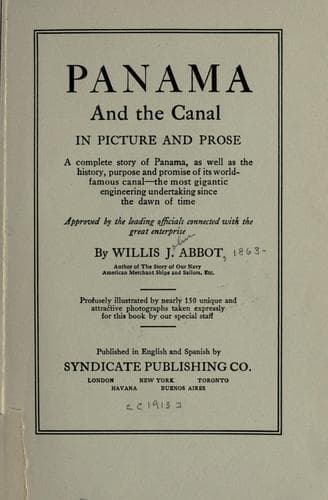
Panama and the Canal in Picture and ProseAbbot, Willis J. (Willis John)
History
Panama and the Canal in Picture and Prose
Abbot, Willis J. (Willis John)
Panama Canal (Panama) -- History
The town thus named became for a time the principal Spanish port on the
Caribbean coast and one of the two terminals of the royal road to Old
Panama. But the harbor was poor, the climate sickly, for the town was
shut in on the landward side by mountains which excluded the breeze. It
came to be called the Spanish Graveyard. Children died in infancy, and
Spanish mothers sent theirs to Cruces to be reared. Difficult of defense
by either land or sea it was menaced alternately by the Cimmaroons and
the English, and in 1572 Sir Francis Drake took it by assault but
gained little profit by the adventure, in which he nearly lost his life.
Warned by this, and by other attacks, a distinguished Spanish engineer
was sent to examine Nombre de Dios with other Caribbean ports.
[Illustration: ENTRANCE TO PORTO BELLO HARBOR, FROM SPANISH FORT]
He was impressed by Porto Bello and reported “if it might please your
Majesty it were well that the city of Nombre de Dios be brought and
builded in this harbor.” It was so graciously ordered and the “city”
having been “brought and builded” at Porto Bello its old site gradually
relapsed into wilderness save for the few huts found when the American
engineers descended upon it seeking not gold but sand. In the course of
this quest they uncovered an old Spanish galleon but did not report any
pieces of eight, ingots or doubloons. Indeed looking all over the Canal
work we may well say, never was there so much digging for so little
treasure, for even in the great Culebra cut no trace of precious metal
was found.
Nombre de Dios then affords little encouragement for the visits of
tourists, but Porto Bello, nearer Colon, is well worth a visit. The
visit however is not easily made. The trip by sea is twenty miles
steaming in the open Caribbean which is always rough, and which on this
passage seems to any save the most hardened navigators tempestuous
beyond all other oceans. There are, or rather were, no regular lines of
boats running from Colon and one desiring to visit the historic spot
must needs plead with the Canal Commission for a pass on the government
tug which makes the voyage daily. The visit is well worth the trouble
however for the ruins are among the finest on the American continent,
while the bay itself is a noble inlet. So at least Columbus thought it
when he first visited it in 1502. His son, Fernando, who afterwards
wrote of this fourth voyage of the Genoese navigator, tells of this
visit thus:
[Illustration: BULLOCK CART ON THE SAVANNA ROAD]
[Illustration: MODERN INDIAN, DARIEN REGION
Note characteristic weapons--machete, javelin and shot-gun]
Public-domain text, read in full here on John Shaqi.
Reviews
Reviews
No reviews yet
Be the first to share your thoughts on this work.
Elsewhere in the archive
Join the Discussion
Join the discussion
Sign in to leave a comment or review.
Sign InorCreate an account