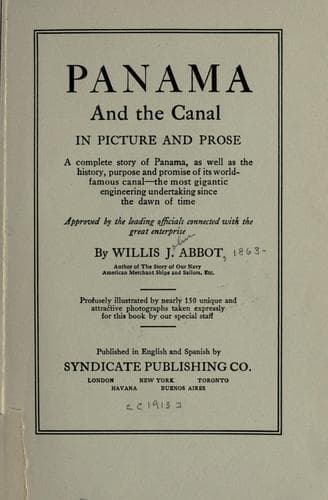
Panama and the Canal in Picture and ProseAbbot, Willis J. (Willis John)
History
Panama and the Canal in Picture and Prose
Abbot, Willis J. (Willis John)
Panama Canal (Panama) -- History
“The Admiral without making any stay went on till he put into Puerto
Bello, giving it that name because it is large, well peopled and
encompassed by a well cultivated country. He entered the place on the
2nd of November (1502), passing between two small islands within which
ships may lie close to the shore and turn it out (sic) if they have
occasion. The country about the harbor, higher up, is not very rough but
tilled and full of houses, a stone’s throw or a bow shot one from the
other; and it looks like the finest landscape a man can imagine. During
seven days we continued there, on account of the rain and ill weather,
there came continually canoes from all the country about to trade, for
provisions, and bottoms of fine spun cotton which they gave for some
trifles such as points and pins.”
Time changes, and things and places change with it. What are “bottoms of
fine spun cotton” and “trifles such as points”? As for the people whose
houses then so plentifully besprinkled the landscape round about, they
have largely vanished. Slain in battle, murdered in cold blood, or
enslaved and worked to death by the barbarous Spaniards, they have given
place to a mongrel race mainly negro, and of them even there are not
enough to give to Porto Bello today the cheery, well populated air which
the younger Columbus noticed more than 400 years ago.
The real foundation date of Porto Bello is fixed at 1607, though
probably the moving thither of Nombre de Dios began earlier. Its full
name in Spanish was San Felipe de Puertovello, for the pious Spaniards
were hard put to it to name a city, a mountain, a cape or a carouse
without bringing in a saint. Typically enough San Felipe was soon
forgotten and the name became Puerto Bello or beautiful harbor. It grew
rapidly, for, as already noted, the city of Nombre de Dios was reërected
there. By 1618 there were 130 houses in the main town not counting the
suburbs, a cathedral, governor’s house, kings’ houses, a monastery,
convent of mercy and hospital, a plaza and a quay. The main city was
well-built, partly of stone or brick, but the suburbs, one of which was
set aside for free negroes, were chiefly of wattled canes with palm
thatch. A few plantations and gardens bordered on the city, but mainly
the green jungle came down to the very edge as it does with Chagres,
Cruces or other native towns today.
Public-domain text, read in full here on John Shaqi.
Reviews
Reviews
No reviews yet
Be the first to share your thoughts on this work.
Elsewhere in the archive
Join the Discussion
Join the discussion
Sign in to leave a comment or review.
Sign InorCreate an account