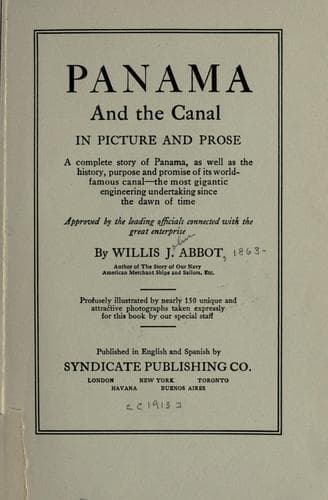
Panama and the Canal in Picture and ProseAbbot, Willis J. (Willis John)
History
Panama and the Canal in Picture and Prose
Abbot, Willis J. (Willis John)
Panama Canal (Panama) -- History
As this Spanish trade increased the corsairs or buccaneers sprung into
being--plain pirates, who preyed on Spanish commerce alone, finding
excuse in the fact that the Spanish were Catholics, or in the plea that
Spain had no right to monopolize American trade. The excuses were mere
subterfuges, but served in a day when piracy was winked at. The men
offering them were not animated by religious convictions, nor would they
have engaged in the American trade if permitted. For them the more
exciting and profitable pursuit of piracy, and this they pushed with
such vigor that by 1526 the merchant vessels in the trade would sail
together in one fleet guarded by men-of-war. At times these fleets
numbered as many as forty sail, all carrying guns. The system of
trade--all regulated by royal decree--was for the ships to sail for
Cartagena on the coast of Colombia, a voyage occupying usually about two
months. Arrived there, a courier was sent to Porto Bello and on to
Panama with tidings of the approach of the fleet. Other couriers spread
the tidings throughout the northern provinces of South America.
[Illustration: _Photo by Underwood and Underwood_
SAN BLAS LUGGERS AT ANCHOR]
The fleet would commonly stay at Cartagena a month, though local
merchants often bribed the general in command to delay it longer. For
with the arrival of the ships the town awoke to a brief and delirious
period of trading. Merchants flocked to Cartagena with indigo, tobacco
and cocoa from Venezuela, gold and emeralds from New Granada, pearls
from Margarita and products of divers sorts from the neighboring lands.
While this business was in progress, and the newly laden galleons were
creeping along the coast to Nombre de Dios and Porto Bello, word had
been sent to Lima for the plate fleet to come to Panama bearing the
tribute to the King--gold stripped from the walls of temples, pearls
pried from the eyes of sacred images, ornaments wrested from the arms
and necks of native women by a rude and ribald soldiery. With the plate
fleet came also numerous vessels taking advantage of the convoy, though
indeed there was little danger from pirates on the Pacific. The
Atlantic, being nearer European civilization, swarmed with these gentry.
[Illustration: THE TEETH OE THE TROPICS
Skeletonized jaws of a Bayano river crocodile]
Public-domain text, read in full here on John Shaqi.
Reviews
Reviews
No reviews yet
Be the first to share your thoughts on this work.
Elsewhere in the archive
Join the Discussion
Join the discussion
Sign in to leave a comment or review.
Sign InorCreate an account