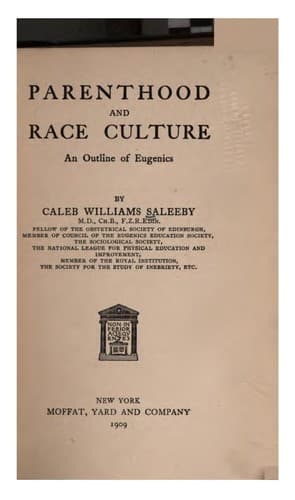
Parenthood and Race Culture: An Outline of EugenicsSaleeby, C. W. (Caleb Williams)
Philosophy
Parenthood and Race Culture: An Outline of Eugenics
Saleeby, C. W. (Caleb Williams)
Eugenics
in recognition of the power of inheritance; it is not merely to
dispose of the idea that men are born inherently equal; but it is
also to combat the idea that education is a levelling process. On the
contrary, it accentuates the differences between men. You may confuse
the unpolished pebble and the diamond, but not when education has done
its utmost for both. If education were a process of addition to what
inheritance gives, it would almost level men: the addition of a large
sum to figures such as, say, 1, 2, and 3, would almost obliterate
their original disproportion. But the analogy is with multiplication,
as I have suggested: and the larger the sum by which 1, 2 and 3 are
multiplied, the greater is the disparity between the products. This
is, perhaps, one of the truths of vast importance which the common rim
of contemporary Socialism implicitly denies: though it is of course
abundantly recognised by such a socialist as that master-thinker
Professor Forel. The socialist's panacea, ideal education for all, is
much to be desired, and will accomplish much, as we began by admitting;
but it is not a panacea. Those who believe it to be such do not
understand the nature of education nor its limitations. They should
remember the remark of Epictetus, “the condition and characteristic
of a fool is this: he never expects from himself profit nor harm, but
from externals.” The dogma of the unthinking socialist--who exists,
though he is doubtless rarer than the unthinking individualist--is
that all evil is of economic origin: correct your economics and your
education and you obliterate evil. But it is not so. As Lowell said,
“A great part of human suffering has its root in the nature of man,
and not in that of his institutions.” When by means of eugenics we
can give education the right material to work upon, we shall have a
Utopia, and as for forms of government they may be left for fools to
contest. Forel, incomparably the greatest socialist thinker of the
day, sees this. He makes his Utopian predictions not so much as to
mere externals, like clothing and language, but as regards the kind of
man and woman: and, unlike some writers, he entitles himself to paint
these pictures, for in that great eugenic treatise _Die Sexuel Frage_,
he tells us how to realise them by pedagogic reform working upon the
materials provided by human selection. A paragraph may be quoted from
Forel:--
“Malgré tout l'enthousiasme qu'on doit montrer pour une pédagogie
rationelle, il ne faut jamais oublier qu'elle est incapable de
remplacer la sélection. Elle sert au but immédiat et rapproché, qui
est d'utiliser le mieux possible le matérial humain tel qu'il existe
maintenant. Mais, par elle-même, elle n'améliore en rien la qualité
des germes à venir. Elle peut, néanmoins, grâce à l'instruction
donnée à la jeunesse sur la valeur sociale de la sélection, la
préparer à mettre cette dernière en œuvre.” #/
and another from Spencer:--
Public-domain text, read in full here on John Shaqi.
Reviews
Reviews
No reviews yet
Be the first to share your thoughts on this work.
Elsewhere in the archive
Join the Discussion
Join the discussion
Sign in to leave a comment or review.
Sign InorCreate an account