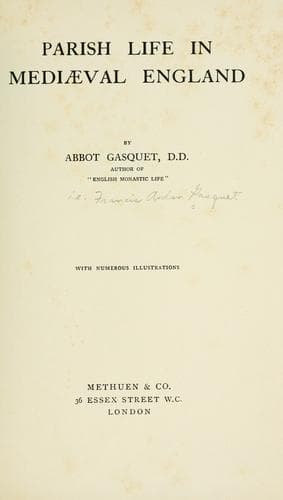
Parish life in mediæval EnglandGasquet, Francis Aidan
History
Parish life in mediæval England
Gasquet, Francis Aidan
England -- Church history -- 1066-1485; England -- Social life and customs -- 1066-1485
Upon the first Monday in Lent all the crucifixes and images of every
kind, both large and small, were covered with white cloths; or in the
case of those niches which had their own wooden doors, these were
closed till the eve of Easter. The linen or silk coverings were worked
or painted with a red cross, and the “red cross” had its peculiar
significance in the ritual of the English Church. The procession on
each Sunday in Lent was not allowed to be headed by the ordinary _Crux
processionalis_, but a wooden cross painted red, in reference to the
shedding of our Lord’s blood upon the cross in the throes of His
crucifixion, was substituted for it. That the practice had a special
meaning to our forefathers seems to be the case, since Sir Thomas More
walked to execution, as Cresacre More says, “carrying in his hands a
red cross.” Langland, too, in his vision makes “Conscience” say that
“These aren Cristes armes.
Hus colours and hus cote-armure, and he that cometh so blody,
Hit is Crist with his crois, conqueror of crystine.”
PALM SUNDAY.--The dramatic ceremonies of Holy Week commenced with those
of Palm Sunday. “This week now begun,” says an old fifteenth-century
writer, “is called _penosa_, because people, in this more than in any
other week, keep their sins before their minds, and mortify themselves
in their sorrow.” From the earliest times, as Ælfric tells us, it was
the custom in England on this Sunday that “the priest should bless
palm-twigs and distribute them so blessed to the people,” and that then
the people should go forth in procession with him, singing the “hymn
which the Jewish people sang before Christ when He was approaching to
His Passion.” The so-called “palms” in England were probably willow,
box, and yew, charges for which appear in the churchwardens’ accounts.
In fact, one sixteenth-century authority states that the yew trees so
frequently to be found in the neighbourhood of churches were planted in
the churchyards of England to furnish the yew-branches which usually
served for palms on Palm Sunday.
Dr. Rock thus describes the procession and other ceremonies in the
first part of the service on this day--
Public-domain text, read in full here on John Shaqi.
Reviews
Reviews
No reviews yet
Be the first to share your thoughts on this work.
Elsewhere in the archive
Join the Discussion
Join the discussion
Sign in to leave a comment or review.
Sign InorCreate an account