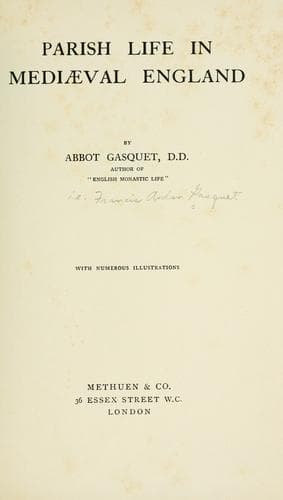
Parish life in mediæval EnglandGasquet, Francis Aidan
History
Parish life in mediæval England
Gasquet, Francis Aidan
England -- Church history -- 1066-1485; England -- Social life and customs -- 1066-1485
Some of the “fraternities” were merely spiritual associations, which
helped to strengthen the bond of brotherhood between parishes. One
such existed in connection with the Cathedral of Lichfield, called
the “Fraternity of the Brethren and Sisters of St. Chad.” Enrolled
as members are many bishops, abbots, priors, and other religious
superiors, besides priests and all sorts and conditions of lay people.
The priests were all pledged to say Masses for the welfare of the
associates, living or dead. Thus, in each of the abbeys of Darley,
Burton, and Shrewsbury, 100 Masses were said yearly for this end; at
Trentham Priory 60 Masses; and at the Convent of Derby 300 psalters by
the Benedictine Nuns were said for the associates. In the Cathedral
church of Lichfield also four Masses were said daily, two for the
living and two for the dead members; and in every associated parish 30
Masses were said during the year. In all these churches, every Sunday
before the Holy Water, the “Our Father” was said by priest and people,
“with hands raised,” followed by a versicle and prayer to St. Chad. In
the fifteenth century, when the bishop gave an indulgence to all those
who were members of the fraternity, he states that this union of prayer
already comprised 2434 Masses and 452 psalters yearly.
The organization of these societies was the same as that which has
existed in similar associations up to the time of our modern trade
unions. A meeting was held, at which officers were elected and accounts
audited; fines for non-acceptance of office were frequently imposed,
as well as for absence from the common meeting. Often members had to
declare, on oath, that they would fulfil their voluntary obligations,
and would keep secret the affairs of the society. Persons of ill repute
were not admitted, and members who disgraced the fraternity were
expelled. For example, the first guild statutes printed by Mr. Toulmin
Smith are those of Garlekhith, London. They begin--
“In worship of God Almighty our Creator and His Mother, Saint Mary,
and all Saints and St. James the Apostle, a fraternity is begun by
good men in the Church of St. James at Garlekhith in London, on the
day of Saint James, the year of our Lord 1375, for the amendment of
their lives and of their souls, and to nourish greater love between
the brethren and sisters of the said brotherhood.”
Each of them have sworn on the Book to perform the points underwritten--
Public-domain text, read in full here on John Shaqi.
Reviews
Reviews
No reviews yet
Be the first to share your thoughts on this work.
Elsewhere in the archive
Join the Discussion
Join the discussion
Sign in to leave a comment or review.
Sign InorCreate an account