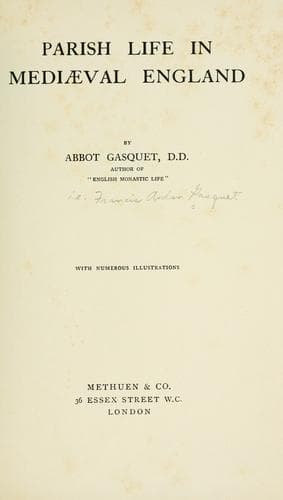
Parish life in mediæval EnglandGasquet, Francis Aidan
History
Parish life in mediæval England
Gasquet, Francis Aidan
England -- Church history -- 1066-1485; England -- Social life and customs -- 1066-1485
And so the parish life at Leverton went on without much change. The
ordinary expenses were met out of the ordinary receipts, and when
anything extraordinary was required the people were apparently ever
ready to come forward to provide it. In 1528 there is a note to
say that “John Bell, quondam Rector,” on his deathbed gave to the
wardens the sum of £6 13_s._ 4_d._ to be used upon the church. In
1531 a curious memorandum is worth recording. It is to this effect:
on October 22, Richard Shepperd, the parson, called a meeting of the
parish, to take into consideration the accounts of the late wardens.
The meeting showed their entire confidence in the priest and their
cordial unanimity with him by asking him to appoint the wardens for
the following year, which he did. Also it was shown to the meeting
that by the last will of Walter Bowsche, of Leverton, three acres of
land had been left to the parish for the purpose of being sold, in
order that with the proceeds a new cope might be bought. The will was
apparently destroyed by the wardens, and the money obtained from the
sale had been spent upon the church work in which at the time they
were chiefly interested, namely, the making of bells. The parishioners
determined that they were in conscience bound to rectify this plain
breach of trust, and to make up the money for the new cope. Lastly, in
1540, the parson, John Wright, presented the parish with a suite of
red-purple vestments, and in recording this gift the wardens note in
their account-book, “for the which you shall all specially pray for the
souls of William Wright and Elizabeth his wife,” the father and mother
of the donor, “and other relations, as well them as be alive as them
that be departed to the mercy of God, for whose lives and souls” these
vestments are given “for the honour of God, His most Blessed Mother,
our Lady St. Mary, and all His saints in heaven, and the blessed matron
St. Helen, his patron, to be used at such principal feasts and times as
it shall please the curates so long as they shall last.”
In this way the names of benefactors and the memory of their good deeds
were ever kept alive in the minds of those who benefited by their
gifts. The parish treasury was not looked on as so much stock, the
accumulation of years, of haphazard donations without definite history
or purpose; but every article, vestment, banner, hanging, chalice,
etc., called up some affectionate memory both of the living and the
dead. On high day and feast day, when all that was best and richest in
the parochial treasury was brought forth to deck the walls and statues
and altars, the display of parish ornaments recalled to the minds of
the people assembled within its walls to worship God the memory of good
deeds done by generations of neighbours for the decoration of their
sanctuary.
Public-domain text, read in full here on John Shaqi.
Reviews
Reviews
No reviews yet
Be the first to share your thoughts on this work.
Join the Discussion
Join the discussion
Sign in to leave a comment or review.
Sign InorCreate an account