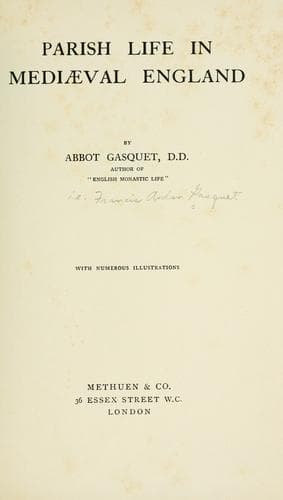
Parish life in mediæval EnglandGasquet, Francis Aidan
History
Parish life in mediæval England
Gasquet, Francis Aidan
England -- Church history -- 1066-1485; England -- Social life and customs -- 1066-1485
“The immense treasures in the churches,” writes Dr. Jessopp, “were the
joy and boast of every man and woman and child in England, who, day by
day and week by week, assembled to worship in the old houses of God
which they and their fathers had built, and whose every vestment and
chalice, and candlestick and banner, organ and bells, and pictures
and images, and altar and shrine, they look upon as their own, and
part of their birthright.”
It might reasonably be supposed that this was true only of the greater
churches; but this is not so. What strikes one so much in these parish
accounts of bygone days is the richness of even small, out-of-the-way
village churches. Where we would naturally be inclined to look for
poverty and meanness, there is evidence to the contrary. To take an
example or two. Morebath is a small, uplandish, remote parish of
little importance on the borders of Exmoor; the population, for the
most part, have spent their energies in daily labour to secure the
bare necessaries of life, and riches, at any rate, could never have
been abundant. Morebath may consequently be taken as a fair sample of
an obscure and poor village. For this hamlet we possess full accounts
from the year 1530, and we find that at this time, and in this very
poor, out-of-the-way place, there were no less than eight separate
accounts kept of money intended for the support of different altars of
devotions. For example, we have the “Stores” of the Chapels of our Lady
and St. George, etc., and the Gilds of the young men and maidens of the
parish. All these were kept and managed by the lay-elected officials
of the societies--confraternities, I suppose, we should call them--and
to their credit are entered numerous gifts of money and specific gifts
of value of kind, such as cows, and swarms of bees, etc. Most of them
had their little capital funds invested in cattle and sheep, the rent
of which proved a considerable part of their revenues. In a word, these
accounts furnish abundant and unmistakeable evidence of the active and
intelligent interest in the duty of supporting and adorning their
church on the part of these simple country folk at large. What is true
of this is true of every other similar account to a greater or less
degree, and all these accounts show unmistakeably that the entire
management of these parish funds was in the hands of the people.
Public-domain text, read in full here on John Shaqi.
Reviews
Reviews
No reviews yet
Be the first to share your thoughts on this work.
Join the Discussion
Join the discussion
Sign in to leave a comment or review.
Sign InorCreate an account