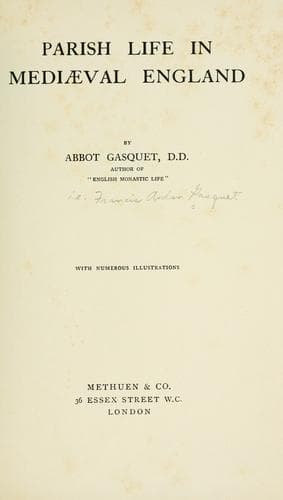
Parish life in mediæval EnglandGasquet, Francis Aidan
History
Parish life in mediæval England
Gasquet, Francis Aidan
England -- Church history -- 1066-1485; England -- Social life and customs -- 1066-1485
Voluntary rates to clear off obligations contracted for the benefit
of the community--such as the purchase of bells, the repair of the
fabric, and even for the making of roads and bridges--were raised by
the wardens. Collections for Peter’s pence, for the support of the
parish clerk, and for every variety of church and local purpose, are
recorded, and the spirit of self-help manifested, on every page of
these accounts. To return to Morebath. In 1528 a complete set of black
vestments was purchased at a cost--considerable in those days--of £6
5_s._, and to help in the common work the vicar gave up certain tithes
in wool that he had been in the habit of receiving. These vestments,
by the way, were only finished and paid for in 1547, just before the
changes under Edward VI. rendered them useless. In 1538 the parish made
a voluntary rate to purchase a new cope, and the general collections
for this purpose produced some £3 6_s._ 8_d._ In 1534 the silver
chalice was stolen, and at once, we are told, “ye yong men and maydens
of ye parysshe dru themselves together, and at ther gyfts and provysyon
they bought in another chalice without any charge of the parish.” Sums
of money, big and small; specific gifts in kind; the stuff or ornaments
needed for vestments, were apparently always forthcoming when needed.
Thus at one time a new cope is suggested, and Anne Tymwell, of Hayne,
gave the churchwardens her “gown and her ring”; Joan Tymwell, a cloak
and a girdle; and Richard Norman, “seven sheep and 3 shillings and 4
pence in money,” towards the cost.
These examples could be multiplied to any extent, but the above will
be sufficient to show the popular working of mediæval parishioners in
support of their church. The same story of local government, popular
interest, and ready self-help, as well as an unmistakeable spirit
of affection for the parish church as theirs--their very own--is
manifested by the people in every account we possess. Every adult of
both sexes had a voice in the system, and the parson was little more in
this regard than chairman of the village meetings, and, as I have more
than once seen him described, “chief parishioner.” In the management
of the fabric, the service, and all things necessary for the due
performance of these, the people were not merely called upon to pay,
but it is clear the diocesan authorities evidently left to the parish
a wise discretion. No doubt the higher ecclesiastical officials could
interfere in theory, but in practice interference was obviously and
wisely rare. It will be necessary in a subsequent chapter to describe
the various methods employed to replenish the parochial exchequer.
There was apparently seldom much difficulty in finding the necessary
money, and it will be of interest to see how it was expended by some
further examples.
CHAPTER III
THE PARISH CHURCH (_continued_)
Public-domain text, read in full here on John Shaqi.
Reviews
Reviews
No reviews yet
Be the first to share your thoughts on this work.
Join the Discussion
Join the discussion
Sign in to leave a comment or review.
Sign InorCreate an account