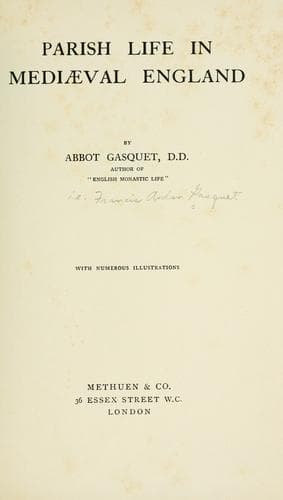
Parish life in mediæval EnglandGasquet, Francis Aidan
History
Parish life in mediæval England
Gasquet, Francis Aidan
England -- Church history -- 1066-1485; England -- Social life and customs -- 1066-1485
In the north wall of English churches, not unfrequently there was a
niche for the lamp, which was always kept burning when the Blessed
Sacrament was reserved on the altar. A good example of such a niche was
discovered some years ago during the restoration of the parish church
of West Grinstead. The smoke from the burning lamp in this instance had
been allowed to escape by means of some loose stones leading to the
eaves of the chancel wall, and when discovered the black of the smoke
was still upon the upper stones of the niche.
Lastly, in recalling the chief features of a pre-Reformation chancel,
what is called in the Constitution of Archbishop Winchelsea “the
principal image” must not be forgotten. This image was that of the
saint or saints, to whom the church was dedicated, and it was one of
the ornaments which the parish was specially called upon to provide.
From the wording of the law it might have a place anywhere in the
chancel, but probably it would have stood in a niche on one side of the
altar; or, in the case of there being two patrons, the statues would
have been placed on either side.
Frequent mention is made in wills of the fifteenth and sixteenth
centuries of the desire of testators to beautify the chancels of
the churches in which during life they had worshipped. Thus William
Graystoke, of Wakefield, left to the church there in 1508 “a cloth of
Arras work, sometime hanging in his hall”: £10 “to the stalling of
the said church: two pairs of censers, and £20 for new choir books.”
Another testator, Thomas Wood, of Hull, who had been a draper and
sheriff and mayor of his city, on his death bequeathed to Trinity Church
“one of my best beds of Arreys work, upon condition that after my
decease I will that the said bed shall yearly cover my grave at my
_Dirge_ and _Masse_, done in the said Trinity Church with note for
evermore; and also I will that the same bed be hung yearly in the
said church at the feast of St. George the Martyr, among the other
worshipfulle beds; and when the said beds be taken down and delivered,
then I will that the same bed be re-delivered into the vestry and
there to remain with my cope of gold.”
Another testator, in 1504, this time a priest, and the rector of
Lowthorpe in Yorkshire, leaves to the church of Catton a bed-cover
with big figures on it, to lie before the high altar on the chief
feasts; and another bed-cover with the figure of a lion, to lie before
the high altar of Lowthorpe, on all the great festivals.
Public-domain text, read in full here on John Shaqi.
Reviews
Reviews
No reviews yet
Be the first to share your thoughts on this work.
Join the Discussion
Join the discussion
Sign in to leave a comment or review.
Sign InorCreate an account