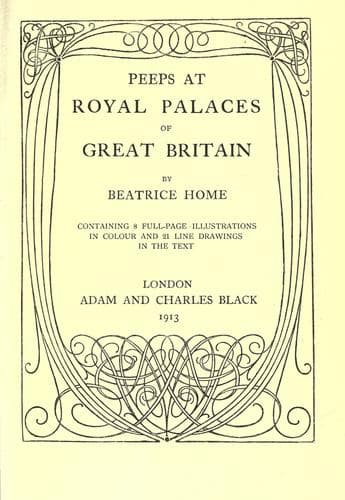
Peeps at Royal Palaces of Great BritainHome, Beatrice
History
Peeps at Royal Palaces of Great Britain
Home, Beatrice
Palaces -- Great Britain
There are no myths or legends connected with the building of London's
great fortress, the clear light of history beats upon the erection of
its walls. It was built by William the Conquerer, not as a protection
for the city, but as a proof of his dominating power over the subdued
but possibly troublesome citizens. Part of the Roman wall which
encircled the city was removed, and the tower rose into being upon the
easternmost corner of Saxon London, right on the shore of the River
Thames, the great highway from the sea. Various additions were made by
succeeding monarchs down to Edward III., until it assumed the shape
we now see it, with the solid Norman keep in the centre, an inner wall
with twelve towers, protected by a strong outer wall surrounded by a
deep moat. Only four gateways gave entrance to the fortress, and those
were strongly guarded by towers. Any enemy attempting to enter from
Tower Hill had to force his way across three branches of the moat,
with three successive towers before he could reach the inner wall of
the citadel. There were three gateways from the river, a small postern
gate for the use of State visitors, the main water gate, which earned
the ominous title of Traitor's Gate, due to the frequent arrival of
State prisoners, and another entrance east of the Traitor's Gate.
Owing to its immense strength it was more commonly used by the Kings
during times of civil war, when from behind its bastioned walls they
could bid defiance to the surging mobs outside. John, Edward II.,
Henry VI., and Edward IV. all retreated there for safety during their
troublous reigns, but it is with Richard II., the boy-King, that we
associate one of the most dangerous episodes in the eventful life
of the city. One midsummer day in 1381 a frenzied mob of countrymen
swarmed on Tower Hill, demanding, with no uncertain voice, a redress
of grievances. Within the Tower there was great hesitation, the
councillors of fifteen-year-old Richard vacillating between a sally
with force upon the ill-armed peasants and a granting of their just
demands. With something of the insistence of the market-women of Paris
when they swarmed up to the gates of Versailles, the savage crowd
gained admittance into the Tower, searching for their supposed enemy,
the Archbishop of Canterbury, who, as the chief lawyer in England,
represented the men who enslaved and starved them. Seizing the poor
old man, they dragged him out to Tower Hill, and, with their summary
judgment, cut off his head then and there. The story of how Richard
saved the situation at Smithfield after the death of Wat Tyler is well
known.
Nothing now remains of the palace where the Plantagenet Kings held
their Court. It was situated between the White Tower and the Wakefield
and Lanthorn Towers. Scarcely used after the reign of Henry VII., save
for three days previous to the Coronation procession through the city,
it was completely demolished in the reign of William and Mary, every
fragment being removed.
Public-domain text, read in full here on John Shaqi.
Reviews
Reviews
No reviews yet
Be the first to share your thoughts on this work.
Join the Discussion
Join the discussion
Sign in to leave a comment or review.
Sign InorCreate an account