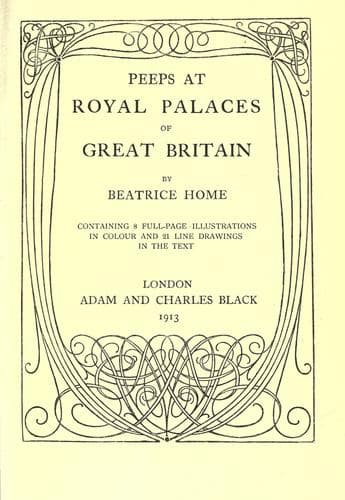
Peeps at Royal Palaces of Great BritainHome, Beatrice
History
Peeps at Royal Palaces of Great Britain
Home, Beatrice
Palaces -- Great Britain
[Illustration: The Keep, or White Tower.]
The most romantic as well as the most pathetic incidents in the
history of the Tower are connected with its forlorn prisoners,
doomed to long incarceration or speedy death at the will of despotic
monarchs. Even the sovereigns themselves were often captives within
its walls. The two young Princes, Edward V. and his brother Richard,
entered the Tower under the nominal protection of their uncle Richard
III., never to appear again. Anne Boleyn returned as a prisoner to
the place which she had formerly entered in triumph just before her
Coronation. Retaining her gay spirit to the end, Anne laughingly
remarked that she had a little neck, when told that death by execution
was quite painless. During the reign of her sister Mary, Queen
Elizabeth was brought through the Traitor's Gate to the Tower, where
she was confined for some time under suspicion of being implicated in
Sir Thomas Wyatt's rebellion.
Though ceasing to be a royal palace, and of little use as a fortress,
the Tower retained its position as a State prison until 1820, becoming
since then merely a barracks and a guard-house for the Crown jewels.
CHAPTER IV
KENNINGTON PALACE
No royal house has more completely vanished from sight, and even from
memory, than the royal palace of Kennington. Few know that such a
palace ever existed, and certainly those who dwell upon its site would
require to be possessed of keen imaginations, to realize that once all
the pageantry of a medieval Court took place, where to-day monotonous
streets crowd upon one another. Yet Parliaments assembled and all
the ceremonies of State were performed on a spot not far from where
Kennington Park now stands. The whim of royal fancy was the cause of
the complete obliteration of the palace, other royal houses pleasing
the later Kings more than the one upon Lambeth Marsh. Low-lying
ground, only redeemed from complete marshland by the embankment of the
river, lay between it and the City of London on the north. As it was
not until quite the end of the eighteenth century that houses began
to be built upon this district, the land being up till then used
as market-gardens, it is not surprising that when the palace was
destroyed it soon passed from men's minds, no one living in the
neighbourhood. The exact date of the destruction of the palace is not
known, but its oblivion was almost complete when Camden, the great
antiquarian, wrote in 1607, for he says: "The Royal seat call'd
Kennington, whither the Kings of England us'd to retire, the discovery
whereof 'tis vain to endeavour after, there appearing neither name nor
rubbish to direct us."
Public-domain text, read in full here on John Shaqi.
Reviews
Reviews
No reviews yet
Be the first to share your thoughts on this work.
Join the Discussion
Join the discussion
Sign in to leave a comment or review.
Sign InorCreate an account