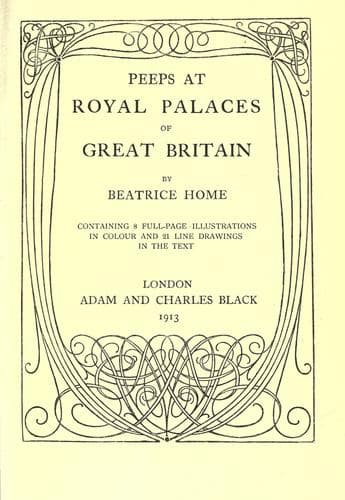
Peeps at Royal Palaces of Great BritainHome, Beatrice
History
Peeps at Royal Palaces of Great Britain
Home, Beatrice
Palaces -- Great Britain
Born at Greenwich in 1491, baptized in the former parish church in a
silver font "well padded with soft linen," Henry VIII. spent much
of his time at his birthplace. He rebuilt the palace, erecting an
unfortified dwelling, the sovereigns no longer requiring to dwell
within a castle. His two daughters, Mary and Elizabeth, were born in
the palace, their royal father, though disappointed at the non-arrival
of a Prince, ordering all reverence to be paid to the infant
Princesses. Queen Katharine of Aragon spent some happy years at
Greenwich before Henry was led away by the charms of Anne Boleyn.
Henry at that time seems to have been full of buoyant life and
good-humour, enjoying the rough and tumble of tournaments in the park,
riding out in the early morning of the First of May to bring in the
blossom, and rollicking in the dances and pageants of the time. It
was at one of the tournaments that Henry last saw Anne Boleyn, who
was acting the part of the Queen of Beauty. Taking offence at her
behaviour, the headstrong King got up suddenly and set off for
London, never again seeing his unfortunate wife, who was arrested the
following day and carried to the Tower.
After the time of James I., who, with his Queen, much delighted in its
situation, the palace fell gradually into decay, so that Charles II.
pulled it all down and started to rebuild a new one. He never lived
in it, for only one wing--that which now faces the building devoted to
the Museum--was ever erected, the scheme of the palace being rejected
for quite another purpose. The gentle, kindly heart of Queen Mary,
the beloved wife of William III., was so moved by the suffering of the
wounded sailors after the Battle of La Hogue, that she determined
that the neglected palace should be furnished as a hospital for those
seamen "who had protected the public safety." Sir Christopher
Wren furnished the design, and King William, private donors, and
Parliamentary grants supplied the endowment of the hospital, whose
first stone was laid on June 30, 1696. For over a century and a half
invalided sailors were sheltered within the hospital, which was
closed in 1869, pensions being then bestowed instead of residence. The
buildings are now used as a college for naval officers.
Greenwich still retains a sea-faring aspect; on a bright day the
river, full of laden barges and busy little tugs, still sparkles,
while "the noblest of European hospitals" remains as "a memorial of
the virtues of the good Queen Mary, of the love and sorrow of William,
and of the great victory of La Hogue."
CHAPTER VII
WHITEHALL PALACE
Public-domain text, read in full here on John Shaqi.
Reviews
Reviews
No reviews yet
Be the first to share your thoughts on this work.
Join the Discussion
Join the discussion
Sign in to leave a comment or review.
Sign InorCreate an account