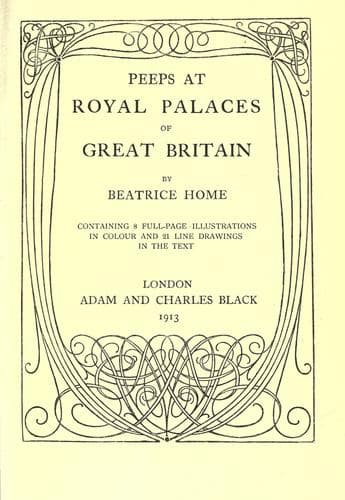
Peeps at Royal Palaces of Great Britain — John Shaqi
Peeps at Royal Palaces of Great BritainHome, Beatrice
History
Peeps at Royal Palaces of Great Britain
Home, Beatrice
Palaces -- Great Britain
Of all the many palaces of the English monarchs, none is more
associated in men's minds with the splendour and pageantry of Court
life than the palace of Whitehall. In comparison with other palaces,
such as Windsor, its life-story was very brief, just over a century
and a half, but it was spent in the hey-day of royalty, when the
Kings were freed from the power of the great barons, and were not
yet controlled by the constitution. It is full of memories of the
masterful Tudors, and the pleasure-loving Stuarts, a period stored
with great and stirring happenings, just when the New World was being
discovered, the New Learning flooding over Europe, and the Reformation
stirring the hearts of men. Yet of all its vast size, only a tiny
fragment is left--the banqueting hall of the magnificent palace
designed by Inigo Jones--and not a brick or stone remains of the
palace where Wolsey reigned in his episcopal glory, and Henry VIII.
held his gorgeous Court.
The first house on the site of the palace belonged to Hubert de Burgh,
the patriotic ruler of England during the minority of Henry III.,
but remembered most generally as the unwilling gaoler of young Prince
Arthur. He bequeathed his property to the Black Friars, in whose
church in Holborn he was buried. Not long afterwards the Dominicans
sold the house to Walter de Grey, Archbishop of York, who left it as
a London residence to his successors in the see of York. It will
be remembered that after one of the serious fires that attacked the
palace of Westminster, Edward I. took shelter in the Archbishop's
palace at York Place, as it was then known, and continued to occupy it
during the remainder of his reign.
In his capacity as Archbishop of York, Cardinal Wolsey came into
possession of York Place, which he almost entirely rebuilt. During
his days of greatness Wolsey lived in the utmost magnificence in his
palace, rivalling the King's Court at Westminster. Surrounded by many
hundreds of courtiers, among whom were some of the noblest in the
land, who did not disdain to serve "the butcher's son," Wolsey kept
high state, feasting off gold and silver plate, to the accompaniment
of singing and music, wearing scarlet and gold, and riding on a
crimson velvet saddle, with his feet in stirrups of silver gilt. As an
excuse for the undoubted ostentation of the great cardinal, Sir Walter
Besant maintains that in his time "it was the right and proper use
of wealth to entertain royally; it was part of a rich man to dress
splendidly, to have a troop of gentlemen and valets in his service, to
exhibit tables covered with gold and silver plate, to hang the walls
with beautiful and costly arras. All this was right and proper." But
Wolsey experienced, as so many great men have done, that
"They that stand high have many blasts to shake them,
And when they fall, they dash themselves to pieces."
Public-domain text, read in full here on John Shaqi.
Reviews
Reviews
No reviews yet
Be the first to share your thoughts on this work.
Join the Discussion
Join the discussion
Sign in to leave a comment or review.
Sign InorCreate an account