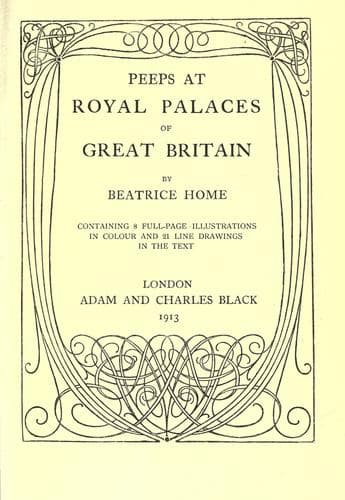
Peeps at Royal Palaces of Great Britain — John Shaqi
Peeps at Royal Palaces of Great BritainHome, Beatrice
History
Peeps at Royal Palaces of Great Britain
Home, Beatrice
Palaces -- Great Britain
Cromwell, conscious of his own integrity and free from superstitious
fears, did not hesitate to occupy the palace outside which his late
monarch had been executed. Though he refused the crown offered to him
in 1657, his residence in Whitehall began to assume more and more
the aspect of a court, he himself gradually acquiring a dignified and
stately manner, as we are assured by the contemporary royalist writer,
Sir Philip Warwick. "And yet I lived to see this very gentleman,"
he writes, "when for six weeks together I was a prisoner in his
sergeant's hands, and daily waited at Whitehall, appear of a great and
majestic deportment and comely presence." After six years of almost
autocratic power as Protector of England, during which period he had
shown his capacity as a statesman, Cromwell breathed his last in the
palace of his royal predecessors, relinquishing his hold upon life, in
spite of his strong religious faith, with obvious reluctance. Worn out
with anxieties and domestic grief, especially over the death of his
much-beloved daughter, Elizabeth Claypole, the great Protector died at
the age of fifty-nine, on September 3, 1658, a day which he had always
accounted as peculiarly fortunate, having been the occasion of his
victories at Dunbar and Worcester. A tremendous storm, one of the most
violent ever known, was raging over England when Oliver Cromwell's
spirit passed into the great Unknown.
On his arrival in London after his restoration, Charles II. proceeded
to Whitehall, where he confirmed all the great charters of English
liberty, such as Magna Carta, and the Petition of Right. Two years
later, Charles brought his unhappy young bride by river in state
to Whitehall, after their honeymoon at Hampton Court. Samuel Pepys
watched the pageant from the top of the banqueting hall, which he
describes as "a most pleasant place as any I could have got." The
whole river was covered with boats and barges, "so that we could see
no water for them," some boats representing the mimic court of a King
and Queen, until the actual royal pair appeared, who were greeted with
guns on their arrival at Whitehall Bridge.
Public-domain text, read in full here on John Shaqi.
Reviews
Reviews
No reviews yet
Be the first to share your thoughts on this work.
Join the Discussion
Join the discussion
Sign in to leave a comment or review.
Sign InorCreate an account