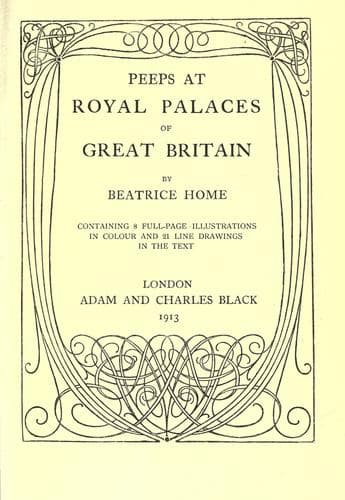
Peeps at Royal Palaces of Great Britain — John Shaqi
Peeps at Royal Palaces of Great BritainHome, Beatrice
History
Peeps at Royal Palaces of Great Britain
Home, Beatrice
Palaces -- Great Britain
Whitehall, so intimately connected with the Tudors, fell with the
Stuarts. A fire, which raged furiously all one night, destroyed for
ever, in 1698, the old rambling palace known to Wolsey and his royal
master, leaving no fragment to remind us of its existence. Only the
graceful banqueting hall escaped the general conflagration. Plans were
drawn up by Sir Christopher Wren for a new palace, but William III.,
who, suffering from habitual asthma, found the smoke of Whitehall
almost intolerable, was not likely to be anxious to restore a palace
in which he could not live. As he wrote to one of his friends, "the
loss is less to me than it would be to another person, for I cannot
live there." But though he made little effort to rebuild the palace,
being already busy at altering Hampton Court, there is no truth in the
statement of his enemies, that William had partly inspired the fire.
George I. altered the banqueting-hall into a Chapel Royal, for which
purpose it continued to be used until 1890, when Queen Victoria gave
permission for the building to be used for the United Service Museum.
CHAPTER VIII
HAMPTON COURT PALACE
In the high tide of its popularity, Hampton Court Palace was
considered the finest and most commodious palace in England, an
opinion which was corroborated by the foreign ambassadors of the time,
who spoke of it in terms of the highest praise. One distinguished
foreign visitor, in the reign of Queen Elizabeth, recorded in his
diary: "This is the most splendid and most magnificent royal palace of
any that may be found in England, or, indeed, in any other kingdom."
And though to-day the tide of royal favour has receded for ever from
the shores of Hampton Court, the palace remains as stately and as
dignified as when the proud Wolsey paced its galleries.
[Illustration: Hampton Court: The First Court.]
Its situation has always been a happy one, for though built on the
banks of the River Thames, it has avoided all the disadvantages
of damp, owing to the gravelly nature of its soil. The nearness to
London, only thirteen miles away, with easy access along the broad
river, made it a delightful residence for the monarchs who were able
to get to and fro from London, however bad the roads might be. When
wearied with the smoke and bustle that surrounded Whitehall, the
royal owners rejoiced in escaping to their beautiful palace at Hampton
Court, from whose windows they looked over the clean river, across
fresh green meadows to the horizon of the blue Surrey hills.
Public-domain text, read in full here on John Shaqi.
Reviews
Reviews
No reviews yet
Be the first to share your thoughts on this work.
Join the Discussion
Join the discussion
Sign in to leave a comment or review.
Sign InorCreate an account