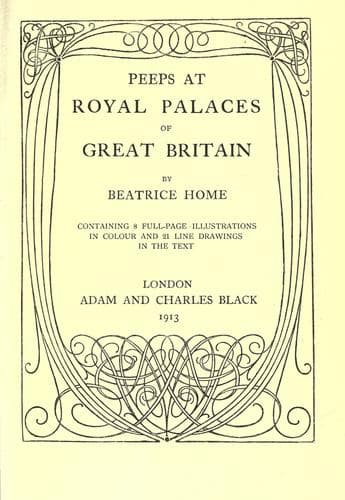
Peeps at Royal Palaces of Great BritainHome, Beatrice
History
Peeps at Royal Palaces of Great Britain
Home, Beatrice
Palaces -- Great Britain
The last monarch to reside and to die in the palace was George II.,
the "petty German autocrat" who scorned England and delighted in
snubbing his English courtiers, declaring, according to Lord Hervey,
that no Englishman knew how to enter a room, nor any Englishwoman
how to dress, nor English cooks how to prepare a dinner, nor English
coachman how to drive, nor, indeed, were there any English horses
fit to ride or drive. Queen Caroline, his much-enduring wife, devoted
herself to the planning out of the gardens, which she laid out
practically as we now see them. Uniting a collection of ponds she
created the Serpentine, and was also responsible for the Round Pond
and the Broad Walk.
George III. did not care for Kensington, much preferring his beloved
Windsor, so that the palace became somewhat neglected, being only used
by various members of the Royal Family. The Duke of Kent, the fourth
son of George III., came to live there shortly after his marriage, the
Princess Victoria being born on May 24, 1819, in the room which now
bears a brass plate commemorating the fact. At the time of her birth
there seemed small likelihood of the little Princess ever reaching
the Throne, but her royal uncles having no children, it soon became
obvious that she was the heir to the Throne of England. She herself,
being brought up with scrupulous care by her widowed mother, did not
know of her great future till the death of George III. The residents
of Kensington soon became familiar with the sight of little Princess
Victoria driving about in a donkey carriage or in a tiny chaise drawn
by small ponies.
A few weeks after her eighteenth birthday, the Princess was awakened
out of her sleep very early on a bright June morning. The Archbishop
of Canterbury and the Lord Chamberlain had arrived at the palace, and
their business could not wait. "We have come to see the _Queen_ on
business of state, and even the Queen's sleep must give way to that."
Hastily putting on a dressing gown and slippers, the young girl went
down, to be told by the Archbishop that her uncle and King was dead,
and that she was now the Queen of a vast inheritance. Later on that
same morning her first council was held in the palace, the scene
depicted by Wilkie in his well-known picture. The young Queen was very
dignified and self-possessed, turning to Lord Melbourne, the Prime
Minister, when doubtful as to what she should do, but showing all
through the trying ordeal a gentle sweetness that won upon all the
lords present. She read her speech "in a clear, distinct, and audible
voice, and without any appearance of fear or embarrassment," after
which all the privy councillors came to kiss her hand and swear
allegiance. When her uncle, the old Duke of Sussex, who was very
infirm, came forward to kneel before her, she left her chair and came
towards him, kissing him on the forehead. On July 13, the girl-Queen
left the home of her childhood for Buckingham Palace.
Public-domain text, read in full here on John Shaqi.
Reviews
Reviews
No reviews yet
Be the first to share your thoughts on this work.
Join the Discussion
Join the discussion
Sign in to leave a comment or review.
Sign InorCreate an account