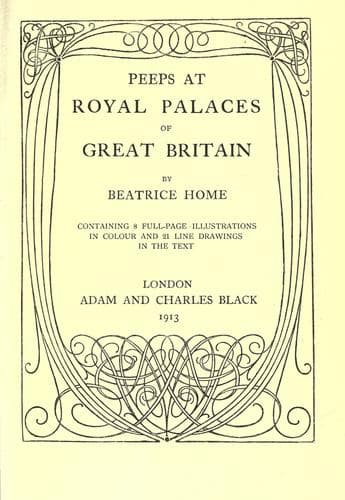
Peeps at Royal Palaces of Great Britain — John Shaqi
Peeps at Royal Palaces of Great BritainHome, Beatrice
History
Peeps at Royal Palaces of Great Britain
Home, Beatrice
Palaces -- Great Britain
Members of the Royal Family continued to occupy various apartments in
the palace, the Duchess of Kent residing there till her death in 1861.
Queen Mary was born there, her parents, the Duke and Duchess of Teck,
living there for a short time.
After some years it was found that the palace was in a very bad state
of repair, every part of the building wanting attention. So extensive
was the dilapidation, that the question of pulling down the palace
was seriously considered. Fortunately, however, the historic place was
saved by Queen Victoria, who was anxious to preserve her old home. It
was finally decided as a memorial of the Diamond Jubilee, to repair
the building thoroughly, and to throw open the State Rooms to the
public. The restoration was carried out most carefully, everything
being saved that was possible; pictures were brought from Hampton
Court, and the whole palace rendered much as it was in the days of its
glory. At the present time it is serving as the temporary home of the
London Museum.
CHAPTER XI
KEW PALACE
Kew first became a royal residence in the reign of George II., when
it was leased from its private owners and used as a country seat by
Frederick, Prince of Wales. Owing to his undutiful behaviour to his
father, the Prince was banished from Court, when he retired to Kew,
forming a sort of opposition Court there. But the actual red-brick
Jacobean house, now known as Kew Palace, was then only called the
Dutch House, after its original founder, Sir Hugh Portman, who was
a Dutch merchant in the time of James I. It stood quite close to the
more important building of Kew House, and was as constantly occupied
by members of the Royal Family as the larger adjacent palace.
The Dutch House, or Kew Palace as it is now designated, is thoroughly
typical of its period--a simple, three gabled, and dignified looking
building, unpalatial indeed, but quite befitting the position of the
wealthy knight who built it. The interior has been altered to suit the
tastes of the royal inmates, who inserted marble fireplaces, and put
in new doors, but a good deal of the original Jacobean panelling still
remains. On the brass locks of the doors are to be seen the Prince of
Wales's feathers, and the cypher of Frederick, Prince of Wales.
[Illustration: Kew Palace (the Dutch House) and George III.'s
Castellated Palace, pulled down by George IV.]
Public-domain text, read in full here on John Shaqi.
Reviews
Reviews
No reviews yet
Be the first to share your thoughts on this work.
Join the Discussion
Join the discussion
Sign in to leave a comment or review.
Sign InorCreate an account