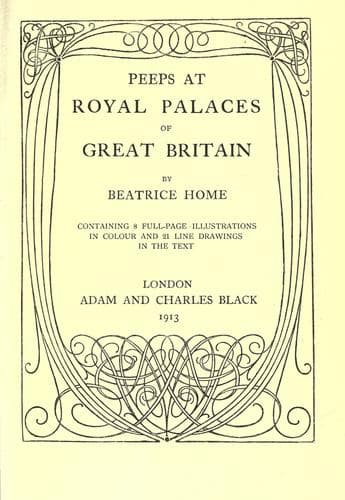
Peeps at Royal Palaces of Great Britain — John Shaqi
Peeps at Royal Palaces of Great BritainHome, Beatrice
History
Peeps at Royal Palaces of Great Britain
Home, Beatrice
Palaces -- Great Britain
It was not until the early Stuart Kings, that Edinburgh Castle really
became a palace, in the more peaceful sense of the word. When James I.
returned to Scotland after his long captivity in England, he spent a
considerable amount of money on building the Parliament House, (now
used as the armoury), and many of the private apartments. He had
doubtless, during his residence at Windsor and Westminster, learnt to
enjoy the greater beauty and dignity of the English palaces. His son,
James II., continued his work of rebuilding.
During the minority of James II., a time when several parties in the
State were endeavouring to capture their young monarch and to rule in
his name, a great tragedy took place within the castle. William, Earl
of Douglas, a lad of about eighteen, was then the head of the most
wealthy and powerful family in Scotland, and being of royal descent,
might even make a claim to the throne.
As he did not join himself to either the party of Sir William Crichton
or that of Sir Alexander Livingstone, these two leaders, usually at
deadly enmity with one another, united to destroy the young Earl.
In the year 1440, the Earl and his brother David were invited to the
castle, on the pretext that the young King wanted their congenial
company. Accompanied by their aged tutor, Sir Malcolm Fleming, the two
boys came to Edinburgh, where they were received with real pleasure by
James II., and with false hospitality by Crichton and Livingstone. But
the real purpose of the visit was evident when a black bull's head was
placed upon the dinner-table, in Scotland as much a symbol of death
as the Judge's black cap in a modern trial. Taken unawares, the
unfortunate boys were hurried to the castle walls, where, after a mock
trial, they were beheaded, Fleming also suffering a similar fate.
After the time of Flodden Field, the monarchs very seldom used the
castle for anything but a stronghold against their enemies, Holyrood
Palace becoming their favourite residence. The last Prince to be born
in the castle was James VI., his mother, Mary Queen of Scots, having
chosen to be within the protection of its strong walls. The small
room in which he was born can still be seen, a memorable room, for the
infant Prince was to bring peace to his realm, putting an end at last
to centuries of conflict, not indeed by any wisdom or foresight of his
own, but by succeeding to the throne of England.
CHAPTER XV
DUNFERMLINE CASTLE
Public-domain text, read in full here on John Shaqi.
Reviews
Reviews
No reviews yet
Be the first to share your thoughts on this work.
Join the Discussion
Join the discussion
Sign in to leave a comment or review.
Sign InorCreate an account