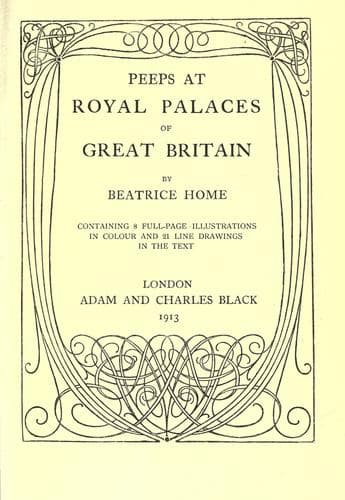
Peeps at Royal Palaces of Great BritainHome, Beatrice
History
Peeps at Royal Palaces of Great Britain
Home, Beatrice
Palaces -- Great Britain
For peaceful beauty of situation the royal palace of Dunfermline
in Fife excelled all others in Scotland, for though the castles of
Edinburgh and Stirling were majestic, they were too associated with
the troubles of turbulent nobles to have been pleasant residences for
the monarchs. The palace was built high above a wooded glen, its walls
apparently rising out of the cliff-like sides of the winding stream.
Only a fragment now remains, but it is sufficient, with its mullioned
windows and massive buttresses, to show how picturesque and stately
must have been the Stuart palace.
The first monarch to reside at Dunfermline was Malcolm Canmore, who
built a castle on Tower Hill, a little distance away from the later
palace. Its site is still to be seen, though the slight remains of the
walls are probably those of its Norman successor. Queen Margaret
lived the greater part of her reign there, spending her days in pious
devotion, giving food and garments to the poor, or sitting with her
maidens working at rich embroideries to adorn the abbey which she
had founded. No frivolous conversation was allowed among the maidens,
their royal mistress being very severe, yet the Queen was much
beloved, for she combined sweetness with her gravity.
It was the presence of the abbey adjoining the palace which made
Dunfermline so dear to Queen Margaret. She was never tired of
enriching her foundation with every gift that saintly enthusiasm
could suggest, and when she died she was naturally buried in the Lady
Chapel. The abbey buildings were destroyed by Edward I., but were
restored by Bruce, who erected the palace near by, deserting the
castle on the hilltop. The reforming energy of the Protestants, in
1560, led them to pull down most of the beautiful church of the abbey,
fortunately leaving the nave, a fine example of Norman work, to be
used for Presbyterian services. So many royal Princes had been buried
in the abbey, from Malcolm Canmore and his Queen, that it has been
sometimes called the "Scottish Westminster," yet the Reformers did
not spare it, though it contained the grave of Robert Bruce. Bruce's
monument being broken, became indistinguishable among the general
ruin, till at the beginning of the nineteenth century the church was
repaired. Some fragments of the tomb were discovered, and on the grave
being opened, the body of Bruce was found wrapped in some remnants
of cloth of gold, which had served as a winding sheet. A new tomb
was made, and after a solemn service the body was reinstalled. Queen
Margaret's tomb is still to be seen among the ruins of the Lady
Chapel.
Public-domain text, read in full here on John Shaqi.
Reviews
Reviews
No reviews yet
Be the first to share your thoughts on this work.
Join the Discussion
Join the discussion
Sign in to leave a comment or review.
Sign InorCreate an account