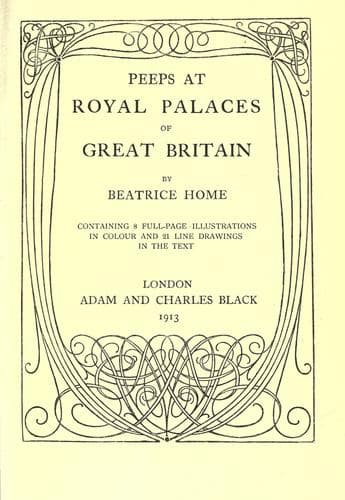
Peeps at Royal Palaces of Great BritainHome, Beatrice
History
Peeps at Royal Palaces of Great Britain
Home, Beatrice
Palaces -- Great Britain
All the other historic rooms have vanished. Nothing is left of the
Painted Chamber, where Edward the Confessor died, the long room whose
painted walls depicted the story of the Confessor's life upon one
side, while the other was devoted to the Wars of the Maccabees. These
paintings were unknown until 1800, when the tapestry that covered them
was removed, and thus revealed the meaning of the room's designation.
Gone, too, is the old House of Lords, used by the peers until the
Commonwealth, where the famous tapestry representing the defeat of
the Spanish Armada was hung. In the vaults underneath, originally the
Confessor's kitchen, Guy Fawkes and his fellow-conspirators stored the
barrels of gunpowder with which to blow up the Parliament. After the
Restoration the Lords removed to the White Hall of the palace,
taking the Armada tapestry with them, which, together with so much of
fascination and historic interest, perished in the all-embracing fire
of 1834.
CHAPTER II
WINDSOR CASTLE
Standing upon a steep chalk cliff that rises abruptly from the River
Thames, Windsor Castle towers above the low-lying river meadows, and,
looking beyond the town that clusters round it, gazes proudly over
twelve adjacent counties. For more than eight centuries a castle has
stood upon this cliff-top, the defensive qualities of such a perfect
natural stronghold having appealed to all the royal rulers of England.
In Saxon times the mound was defended by some kind of wooden palisade,
which William the Conqueror replaced with stone, nothing of which
now remains. Henry II., the first of the Plantagenet Kings, built his
palace there, erecting it upon what is known to-day as the Upper Ward,
the castle being divided into three distinct sections or tiers. The
Upper Ward, situated upon a higher level of the plateau, is separated
from the Lower Ward by the Round Tower, which stands upon a mound in
the centre.
Perhaps the most exciting times that the castle ever witnessed took
place in the reign of John; certainly one of the most important events
in the history of the English people is connected with its grey walls.
John had filled the castle with mercenary troops, with which to defend
himself against his insurgent barons. Protected by these foreigners,
who fought with extreme bravery, the castle sustained two sieges, the
only active warfare in which it took any serious part. Owing doubtless
to its almost impregnable situation before the days of artillery, it
remained calm and secure, however disturbed other parts of the kingdom
might be. One summer day in the year 1215 King John, overawed by the
great gathering of armed barons within sight of his castle, left his
stronghold on the hill, and full of rage rode down to the meadow of
Runnymede, near Staines. There he was forced to sign the Great Charter
of English Freedom, an action which reduced him to such a pitch of
impotent fury that when he reached the castle again, he rolled on the
ground, gnawing sticks and straws.
Public-domain text, read in full here on John Shaqi.
Reviews
Reviews
No reviews yet
Be the first to share your thoughts on this work.
Join the Discussion
Join the discussion
Sign in to leave a comment or review.
Sign InorCreate an account