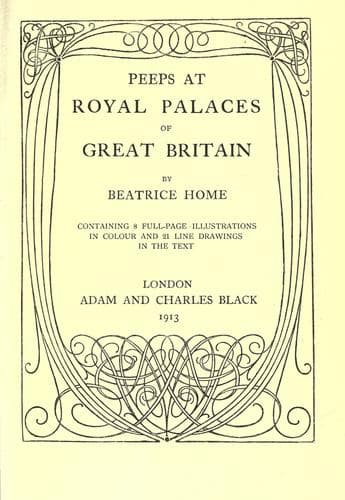
Peeps at Royal Palaces of Great BritainHome, Beatrice
History
Peeps at Royal Palaces of Great Britain
Home, Beatrice
Palaces -- Great Britain
It is to John's son, Henry III., that the present aspect of the castle
is due, for though walls and towers have been rebuilt since his
time, the general appearance remains the same. He was the first great
builder, and beginning early with a reign of over fifty years
before him, he was able to carry out his extensive building schemes.
Deserting the Upper Ward, where all his predecessors had lived, he
built his palace on the Lower plateau, also erecting a chapel on the
site of St. George's. Less than a century after his death palace and
chapel had vanished, fallen into a rapid decay, so that almost the
only records of his work to-day are to be found in the Curfew Tower,
and the Cloisters.
The first King to be born at Windsor was Edward III., who spent great
sums upon his palace, practically rebuilding the whole castle. Being a
great warrior, loving war and glory, he became enamoured with the idea
of founding an Order of Knighthood that should become as illustrious
as that of King Arthur, who was believed to have some connection with
Windsor. A Round Tower was built upon the mound, to hold the Round
Table, and great festivities were held there in 1344, but this
Round Table idea forms no part of the great Order--the Order of the
Garter--instituted in 1348. It is thought that Froissart confused
these two celebrations.
[Illustration: Windsor Castle: Entrance to the Horseshoe Cloisters.]
Under the superintendence of William of Wykeham, afterwards the great
Bishop of Winchester, but employed by Edward III. as his surveyor
of works, the Lower Ward was entirely given up to the service of St.
George, the patron saint of the new Order. This involved the building
of a new palace, which was erected upon the Upper Ward, hitherto
merely walled and left vacant. At the time when these great building
schemes were in progress, there were two captive Kings within the
castle, for Edward did not entirely devote his energy to palace
building, which merely formed a pleasing interlude to the long and
ambitious wars which occupied his life. David II. of Scotland had been
captured at Neville's Cross in 1346, and ten years later John, the
King of France, joined him at Windsor, having fallen to the Black
Prince at Poitiers. It is said that Edward, while walking with his
prisoners, discussed with them the building of his new palace. They
suggested that it would look more regal if it stood upon the Upper
Ward, at which Edward cynically remarked that it should be erected at
the cost of their ransoms. But as King John's ransom was never paid,
and Scotland was too poor a country to provide much even to redeem
their King, Edward was obliged to do most of the paying of the bill
himself.
Public-domain text, read in full here on John Shaqi.
Reviews
Reviews
No reviews yet
Be the first to share your thoughts on this work.
Join the Discussion
Join the discussion
Sign in to leave a comment or review.
Sign InorCreate an account