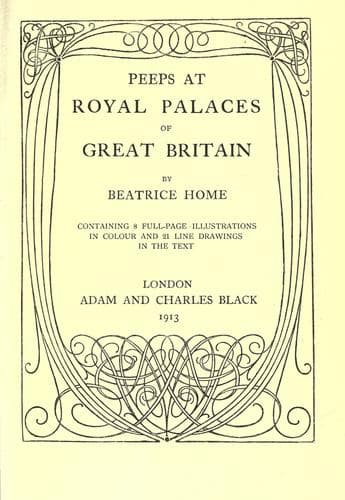
Peeps at Royal Palaces of Great BritainHome, Beatrice
History
Peeps at Royal Palaces of Great Britain
Home, Beatrice
Palaces -- Great Britain
To those who see it for the first time, Holyrood Palace is distinctly
disappointing. All the glamour of its romantic history seems out of
place in connection with the somewhat prosaic looking mansion, which
bears little outward sign of its eventful life. Nothing is left of the
medieval abbey which once stood upon the site, save a ruined portion
of the abbey church. And of the Stuart palace, so associated with the
fascinations of Scotland's most famous Queen, only a small part is
left, though luckily the fire which attacked the palace at the end of
the Civil War spared the apartments used by Mary Queen of Scots. Yet,
disappointing as a first impression may be, Holyrood Palace, to
those who know anything of Scotland's story, can never fail to be
interesting.
The palace was never a fortified building, for it was not used as
a regular royal residence until the more fierce days of warfare had
vanished. Originally an abbey stood at the foot of Arthur's Seat,
being founded by David I., in gratitude for his miraculous escape when
out hunting. According to monkish tradition, the King was saved by the
providential appearance of a cross which interposed between him and
the infuriated stag. Therefore the name of the abbey was called the
Holyrood.
[Illustration: The Bedchamber of Mary Queen of Scots, in Holyrood
Palace.]
Though not a palace until the time of the Stuarts, the early Kings
often held councils there, and continued to show royal favour to the
monks, who had given the name of Canongate to the burgh which arose
outside the city walls. James II., who lies buried in the royal vault
in the chapel, was the first to erect any kind of royal apartments in
the abbey. His successor, James III., lived there, but it was James
IV. who really was the builder of the palace, to which he brought his
wife, Margaret Tudor, the English bride who was eventually to bring
about the union of the crowns. James V. carried on the brilliance of
his father's Court, his two French wives bringing many of the fashions
of their own country to grace their new home. His first wife died soon
after her arrival, but his second wife, Mary of Guise, lived to rule
Scotland through many anxious years of regency, while her infant
daughter was being brought up away from her in distant France.
Public-domain text, read in full here on John Shaqi.
Reviews
Reviews
No reviews yet
Be the first to share your thoughts on this work.
Join the Discussion
Join the discussion
Sign in to leave a comment or review.
Sign InorCreate an account