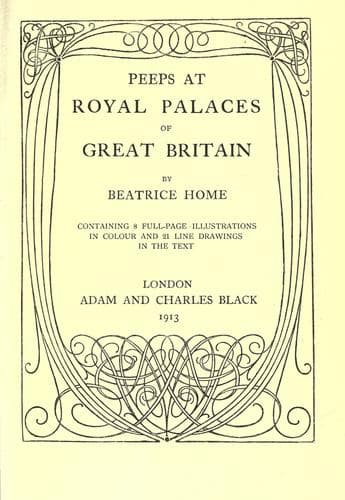
Peeps at Royal Palaces of Great BritainHome, Beatrice
History
Peeps at Royal Palaces of Great Britain
Home, Beatrice
Palaces -- Great Britain
But it was under Mary Queen of Scots that Holyrood became really
famous. She made it her constant and favourite residence. After her
many years of education in France, and her brief career as the wife of
the sickly Francis II., she returned to her native country in August,
1561. John Knox, with the superstition of the age, comments upon the
peculiar fogginess and darkness of the weather which marked the young
Queen's arrival, saying, "that forewarning gave God unto us, but alas!
the most were blind." Bonfires were lit, and great demonstrations of
joy were manifested when Mary took up her abode at Holyrood. A band of
musicians with much zeal but little skill played outside her bedroom
window, being courteously thanked by the Queen; but Brantôme, the
French courtier, who had accompanied Queen Mary from France, complains
in his memoirs of the terrible noise of these musicians who sang
psalms all out of tune; "Quelle musique! et quel repos pour sa nuit"
he writes. The very first Sunday after her arrival was marred by a
tumult outside the Chapel Royal, where Mass was being performed, a
disturbance which was only checked by Lord James Stuart, the Queen's
natural brother, who stood in front of the chapel door, and being a
zealous Protestant himself, managed to check the Reformers.
The palace witnessed three interviews between the great reformer,
John Knox, and his young and beautiful Queen. Using his pulpit as the
opportunity for declaiming against the doings of the Queen and that of
idolators generally, John Knox was called to task by Mary, who ordered
him to appear before her at Holyrood. The first interview took place
in the audience-chamber, leading into the Queen's bedchamber. Only
Lord James Stuart, afterwards the Regent Moray, was present at
the interview, in which Knox answered the Queen's accusations very
cleverly. The second interview was held in the Queen's bedroom, the
room which remains much as she left it, with the actual bed in which
she slept. Off this room were two small rooms, in one of which she
was supping with her Italian secretary, David Riccio, when the band of
armed men, headed by her husband Darnley, burst into the room. Riccio
clung to the Queen's dress, but was torn apart, stabbed, and dragged
out to be despatched with many wounds at the top of the staircase.
Queen Mary's son, James VI., spent some time of every year in the
palace, and restored it when he was expecting his Danish bride.
Public-domain text, read in full here on John Shaqi.
Reviews
Reviews
No reviews yet
Be the first to share your thoughts on this work.
Join the Discussion
Join the discussion
Sign in to leave a comment or review.
Sign InorCreate an account