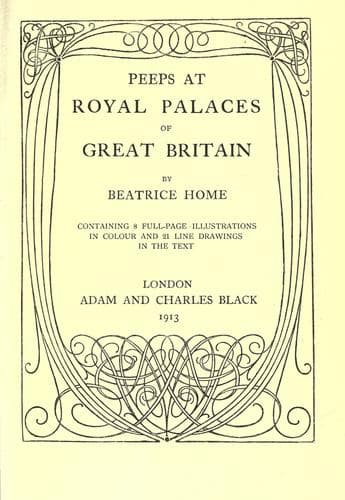
Peeps at Royal Palaces of Great BritainHome, Beatrice
History
Peeps at Royal Palaces of Great Britain
Home, Beatrice
Palaces -- Great Britain
Good Queen Philippa, the sweet woman who had been the gentle
inspiration of Edward's life, fell ill at Windsor in August, 1369, an
illness of which there was "no remedy but death," says Froissart, who
writes very sympathetically of her last moments. Edward, the bravest
knight in Christendom, stood weeping at her bedside as she whispered
to him her last requests, that he should pay her debts, carry on her
charities, and be buried beside her. Froissart tells us that "in all
her life she did neither in thought, word, nor deed, things whereby
to lose her soul." So that he was confident that "the holy angels
received her with great joy up to heaven."
During the reign of Henry V., Windsor again became a royal
prison-house, Scotland's youthful King, James I., spending about ten
years of his life there. He had been captured when quite a lad on his
way to France to be educated, and had received a good education at
the hands of his captors, who had treated him kindly, allowing him
considerable liberty. While at Windsor he met his future queen, then
the Lady Joan Beaufort, the daughter of the Earl of Somerset, whom
he describes in his poem, "The King's Quair," as "the fairest and
freshest youthful flower" he had ever seen. After his release in 1424,
they were married in Southwark Cathedral, setting off immediately
afterwards for Scotland.
"The Royal Saint," as Henry VI. has been called, did not spend time
or money upon his palace at Windsor, but was enthusiastic over the
founding of Eton College, which he erected on the opposite bank of the
winding river, so that he could see it from his palace windows. In his
zealous activity to make this college worthy of the Virgin Mary, in
whose honour it had been founded, poor King Henry forgot his kingdom,
and found himself deposed long before his schemes were perfected. He
lies buried in St. George's Chapel, under a plain stone slab, having
been brought thither from Chertsey Abbey by Richard III., who did not
care for miracles to be performed at his victim's grave, and preferred
to have the body under his own observation.
Public-domain text, read in full here on John Shaqi.
Reviews
Reviews
No reviews yet
Be the first to share your thoughts on this work.
Join the Discussion
Join the discussion
Sign in to leave a comment or review.
Sign InorCreate an account