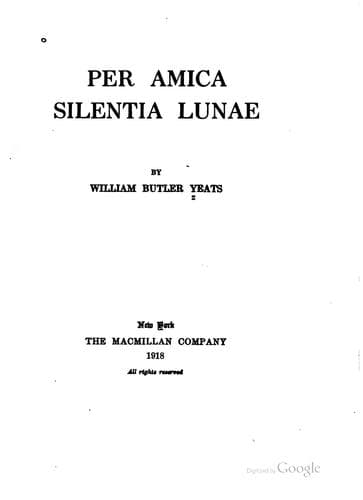
Per Amica Silentia LunaeYeats, W. B. (William Butler)
Philosophy
Per Amica Silentia Lunae
Yeats, W. B. (William Butler)
Essays
All things I then forgot,
My cheek on him who for my coming came;
All ceased and I was not,
Leaving my cares and shame
Among the lilies, and forgetting them."[1]
X
It is not permitted to a man, who takes up pen or chisel, to seek
originality, for passion is his only business, and he cannot but mould or
sing after a new fashion because no disaster is like another. He is like
those phantom lovers in the Japanese play who, compelled to wander side by
side and never mingle, cry: "We neither wake nor sleep and passing our
nights in a sorrow which is in the end a vision, what are these scenes of
spring to us?" If when we have found a mask we fancy that it will not
match our mood till we have touched with gold the cheek, we do it
furtively, and only where the oaks of Dodona cast their deepest shadow,
for could he see our handiwork the Daemon would fling himself out, being
our enemy.
XI
Many years ago I saw, between sleeping and waking, a woman of incredible
beauty shooting an arrow into the sky, and from the moment when I made my
first guess at her meaning I have thought much of the difference between
the winding movement of nature and the straight line, which is called in
Balzac's _Seraphita_ the "Mark of Man," but comes closer to my meaning as
the mark of saint or sage. I think that we who are poets and artists, not
being permitted to shoot beyond the tangible, must go from desire to
weariness and so to desire again, and live but for the moment when vision
comes to our weariness like terrible lightning, in the humility of the
brutes. I do not doubt those heaving circles, those winding arcs, whether
in one man's life or in that of an age, are mathematical, and that some in
the world, or beyond the world, have foreknown the event and pricked upon
the calendar the life-span of a Christ, a Buddha, a Napoleon: that every
movement, in feeling or in thought, prepares in the dark by its own
increasing clarity and confidence its own executioner. We seek reality
with the slow toil of our weakness and are smitten from the boundless and
the unforeseen. Only when we are saint or sage, and renounce Experience
itself, can we, in the language of the Christian Caballa, leave the sudden
lightning and the path of the serpent and become the bowman who aims his
arrow at the centre of the sun.
XII
Public-domain text, read in full here on John Shaqi.
Reviews
Reviews
No reviews yet
Be the first to share your thoughts on this work.
Join the Discussion
Join the discussion
Sign in to leave a comment or review.
Sign InorCreate an account