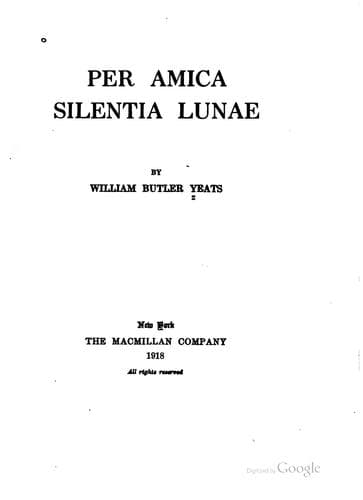
Per Amica Silentia LunaeYeats, W. B. (William Butler)
Philosophy
Per Amica Silentia Lunae
Yeats, W. B. (William Butler)
Essays
The doctors of medicine have discovered that certain dreams of the night,
for I do not grant them all, are the day's unfulfilled desire, and that
our terror of desires condemned by the conscience has distorted and
disturbed our dreams. They have only studied the breaking into dream of
elements that have remained unsatisfied without purifying discouragement.
We can satisfy in life a few of our passions and each passion but a
little, and our characters indeed but differ because no two men bargain
alike. The bargain, the compromise, is always threatened, and when it is
broken we become mad or hysterical or are in some way deluded; and so when
a starved or banished passion shows in a dream we, before awaking, break
the logic that had given it the capacity of action and throw it into chaos
again. But the passions, when we know that they cannot find fulfilment,
become vision; and a vision, whether we wake or sleep, prolongs its power
by rhythm and pattern, the wheel where the world is butterfly. We need no
protection, but it does, for if we become interested in ourselves, in our
own lives, we pass out of the vision. Whether it is we or the vision that
create the pattern, who set the wheel turning, it is hard to say, but
certainly we have a hundred ways of keeping it near us: we select our
images from past times, we turn from our own age and try to feel Chaucer
nearer than the daily paper. It compels us to cover all it cannot
incorporate, and would carry us when it comes in sleep to that moment when
even sleep closes her eyes and dreams begin to dream; and we are taken up
into a clear light and are forgetful even of our own names and actions and
yet in perfect possession of ourselves murmur like Faust, "Stay, moment,"
and murmur in vain.
XIII
A poet, when he is growing old, will ask himself if he cannot keep his
mask and his vision without new bitterness, new disappointment. Could he
if he would, knowing how frail his vigour from youth up, copy Landor who
lived loving and hating, ridiculous and unconquered, into extreme old age,
all lost but the favour of his muses.
The mother of the muses we are taught
Is memory; she has left me; they remain
And shake my shoulder urging me to sing.
Surely, he may think, now that I have found vision and mask I need not
suffer any longer. He will buy perhaps some small old house where like
Ariosto he can dig his garden, and think that in the return of birds and
leaves, or moon and sun, and in the evening flight of the rooks he may
discover rhythm and pattern like those in sleep and so never awake out of
vision. Then he will remember Wordsworth withering into eighty years,
honoured and empty-witted, and climb to some waste room and find,
forgotten there by youth, some bitter crust.
_February_ 25, 1917.
ANIMA MUNDI
I
Public-domain text, read in full here on John Shaqi.
Reviews
Reviews
No reviews yet
Be the first to share your thoughts on this work.
Join the Discussion
Join the discussion
Sign in to leave a comment or review.
Sign InorCreate an account