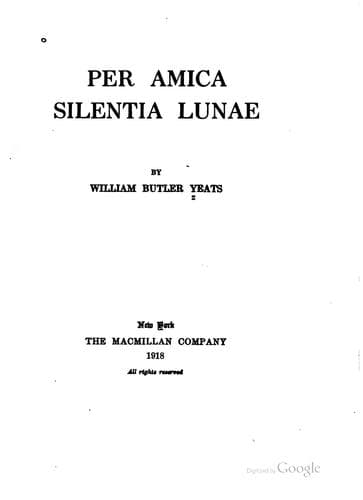
Per Amica Silentia LunaeYeats, W. B. (William Butler)
Philosophy
Per Amica Silentia Lunae
Yeats, W. B. (William Butler)
Essays
I had always to compel myself to fix the imagination upon the minds behind
the personifications, and yet the personifications were themselves living
and vivid. The minds that swayed these seemingly fluid images had
doubtless form, and those images themselves seemed, as it were, mirrored
in a living substance whose form is but change of form. From tradition and
perception, one thought of one's own life as symbolised by earth, the
place of heterogeneous things, the images as mirrored in water and the
images themselves one could divine but as air; and beyond it all there
was, I felt confident, certain aims and governing loves, the fire that
makes all simple. Yet the images themselves were fourfold, and one judged
their meaning in part from the predominance of one out of the four
elements, or that of the fifth element, the veil hiding another four, a
bird born out of the fire.
IV
I longed to know something even if it were but the family and Christian
names of those minds that I could divine, and that yet remained always as
it seemed impersonal. The sense of contact came perhaps but two or three
times with clearness and certainty, but it left among all to whom it came
some trace, a sudden silence, as it were, in the midst of thought or
perhaps at moments of crisis a faint voice. Were our masters right when
they declared so solidly that we should be content to know these presences
that seemed friendly and near but as "the phantom" in Coleridge's poem,
and to think of them perhaps, as having, as St. Thomas says, entered upon
the eternal possession of themselves in one single moment?
"All look and likeness caught from earth,
All accident of kin and birth,
Had passed away. There was no trace
Of ought on that illumined face,
Upraised beneath the rifted stone,
But of one spirit all her own;
She, she herself and only she,
Shone through her body visibly."
V
One night I heard a voice that said: "The love of God for every human soul
is infinite, for every human soul is unique; no other can satisfy the same
need in God." Our masters had not denied that personality outlives the
body or even that its rougher shape may cling to us a while after death,
but only that we should seek it in those who are dead. Yet when I went
among the country people, I found that they sought and found the old
fragilities, infirmities, physiognomies that living stirred affection. The
Spiddal knowledgeable man, who had his knowledge from his sister's ghost,
noticed every hallowe'en, when he met her at the end of the garden, that
her hair was greyer. Had she perhaps to exhaust her allotted years in the
neighbourhood of her home, having died before her time? Because no
authority seemed greater than that of this knowledge running backward to
the beginning of the world, I began that study of spiritism so despised by
Stanislas de Gaeta, the one eloquent learned scholar who has written of
magic in our generation.
VI
Public-domain text, read in full here on John Shaqi.
Reviews
Reviews
No reviews yet
Be the first to share your thoughts on this work.
Join the Discussion
Join the discussion
Sign in to leave a comment or review.
Sign InorCreate an account