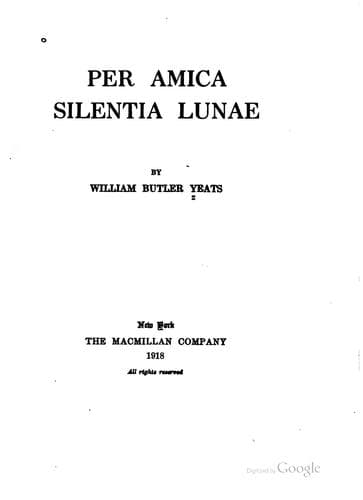
Per Amica Silentia LunaeYeats, W. B. (William Butler)
Philosophy
Per Amica Silentia Lunae
Yeats, W. B. (William Butler)
Essays
I had no natural gift for this clear quiet, as I soon discovered, for my
mind is abnormally restless; and I was seldom delighted by that sudden
luminous definition of form which makes one understand almost in spite of
oneself that one is not merely imagining. I therefore invented a new
process. I had found that after evocation my sleep became at moments full
of light and form, all that I had failed to find while awake; and I
elaborated a symbolism of natural objects that I might give myself dreams
during sleep, or rather visions, for they had none of the confusion of
dreams, by laying upon my pillow or beside my bed certain flowers or
leaves. Even to-day, after twenty years, the exaltations and the messages
that came to me from bits of hawthorn or some other plant seem of all
moments of my life the happiest and the wisest. After a time, perhaps
because the novelty wearing off the symbol lost its power, or because my
work at the Irish Theatre became too exciting, my sleep lost its
responsiveness. I had fellow-scholars, and now it was I and now they who
made some discovery. Before the mind's eye, whether in sleep or waking,
came images that one was to discover presently in some book one had never
read, and after looking in vain for explanation to the current theory of
forgotten personal memory, I came to believe in a great memory passing on
from generation to generation. But that was not enough, for these images
showed intention and choice. They had a relation to what one knew and yet
were an extension of one's knowledge. If no mind was there, why should I
suddenly come upon salt and antimony, upon the liquefaction of the gold,
as they were understood by the alchemists, or upon some detail of
cabalistic symbolism verified at last by a learned scholar from his
never-published manuscripts, and who can have put together so ingeniously,
working by some law of association and yet with clear intention and
personal application, certain mythological images. They had shown
themselves to several minds, a fragment at a time, and had only shown
their meaning when the puzzle picture had been put together. The thought
was again and again before me that this study had created a contact or
mingling with minds who had followed a like study in some other age, and
that these minds still saw and thought and chose. Our daily thought was
certainly but the line of foam at the shallow edge of a vast luminous sea:
Henry More's _Anima Mundi_, Wordsworth's "immortal sea which brought us
hither ... and near whose edge the children sport," and in that sea there
were some who swam or sailed, explorers who perhaps knew all its shores.
III
Public-domain text, read in full here on John Shaqi.
Reviews
Reviews
No reviews yet
Be the first to share your thoughts on this work.
Join the Discussion
Join the discussion
Sign in to leave a comment or review.
Sign InorCreate an account