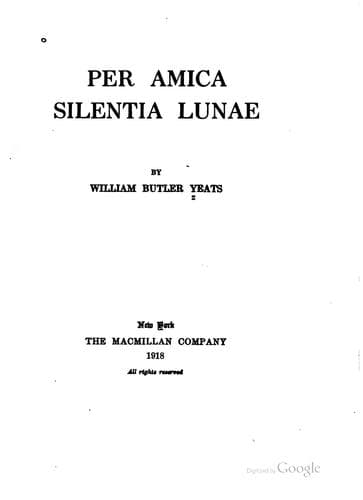
Per Amica Silentia LunaeYeats, W. B. (William Butler)
Philosophy
Per Amica Silentia Lunae
Yeats, W. B. (William Butler)
Essays
When I come home after meeting men who are strange to me, and sometimes
even after talking to women, I go over all I have said in gloom and
disappointment. Perhaps I have overstated everything from a desire to vex
or startle, from hostility that is but fear; or all my natural thoughts
have been drowned by an undisciplined sympathy. My fellow-diners have
hardly seemed of mixed humanity, and how should I keep my head among
images of good and evil, crude allegories.
But when I shut my door and light the candle, I invite a Marmorean Muse,
an art, where no thought or emotion has come to mind because another man
has thought or felt something different, for now there must be no
reaction, action only, and the world must move my heart but to the heart's
discovery of itself, and I begin to dream of eyelids that do not quiver
before the bayonet: all my thoughts have ease and joy, I am all virtue and
confidence. When I come to put in rhyme what I have found it will be a
hard toil, but for a moment I believe I have found myself and not my
anti-self. It is only the shrinking from toil perhaps that convinces me
that I have been no more myself than is the cat the medicinal grass it is
eating in the garden.
How could I have mistaken for myself an heroic condition that from early
boyhood has made me superstitious? That which comes as complete, as
minutely organised, as are those elaborate, brightly lighted buildings and
sceneries appearing in a moment, as I lie between sleeping and waking,
must come from above me and beyond me. At times I remember that place in
Dante where he sees in his chamber the "Lord of Terrible Aspect," and how,
seeming "to rejoice inwardly that it was a marvel to see, speaking, he
said, many things among the which I could understand but few, and of these
this: ego dominus tuus"; or should the conditions come, not as it were in
a gesture--as the image of a man--but in some fine landscape, it is of
Boehme, maybe, that I think, and of that country where we "eternally
solace ourselves in the excellent beautiful flourishing of all manner of
flowers and forms, both trees and plants, and all kinds of fruit."
II
Public-domain text, read in full here on John Shaqi.
Reviews
Reviews
No reviews yet
Be the first to share your thoughts on this work.
Join the Discussion
Join the discussion
Sign in to leave a comment or review.
Sign InorCreate an account