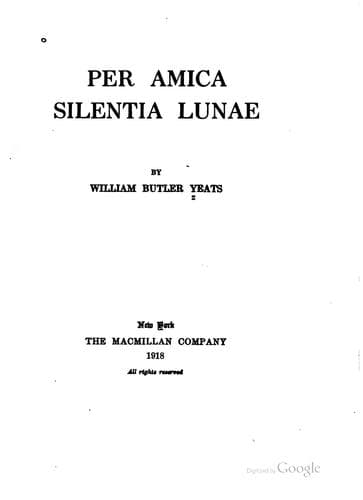
Per Amica Silentia LunaeYeats, W. B. (William Butler)
Philosophy
Per Amica Silentia Lunae
Yeats, W. B. (William Butler)
Essays
When I consider the minds of my friends, among artists and emotional
writers, I discover a like contrast. I have sometimes told one close
friend that her only fault is a habit of harsh judgment with those who
have not her sympathy, and she has written comedies where the wickedest
people seem but bold children. She does not know why she has created that
world where no one is ever judged, a high celebration of indulgence, but
to me it seems that her ideal of beauty is the compensating dream of a
nature wearied out by over-much judgment. I know a famous actress who in
private life is like the captain of some buccaneer ship holding his crew
to good behaviour at the mouth of a blunderbuss, and upon the stage she
excels in the representation of women who stir to pity and to desire
because they need our protection, and is most adorable as one of those
young queens imagined by Maeterlinck who have so little will, so little
self, that they are like shadows sighing at the edge of the world. When I
last saw her in her own house she lived in a torrent of words and
movements, she could not listen, and all about her upon the walls were
women drawn by Burne-Jones in his latest period. She had invited me in the
hope that I would defend those women, who were always listening, and are
as necessary to her as a contemplative Buddha to a Japanese Samurai,
against a French critic who would persuade her to take into her heart in
their stead a Post-Impressionist picture of a fat, ruddy, nude woman lying
upon a Turkey carpet.
There are indeed certain men whose art is less an opposing virtue than a
compensation for some accident of health or circumstance. During the riots
over the first production of the _Playboy of the Western World_ Synge was
confused, without clear thought, and was soon ill--indeed the strain of
that week may perhaps have hastened his death--and he was, as is usual
with gentle and silent men, scrupulously accurate in all his statements.
In his art he made, to delight his ear and his mind's eye, voluble
daredevils who "go romancing through a romping lifetime ... to the dawning
of the Judgment Day." At other moments this man, condemned to the life of
a monk by bad health, takes an amused pleasure in "great queens ... making
themselves matches from the start to the end." Indeed, in all his
imagination he delights in fine physical life, in life where the moon
pulls up the tide. The last act of _Deirdre of the Sorrows_, where his art
is at its noblest, was written upon his death-bed. He was not sure of any
world to come, he was leaving his betrothed and his unwritten play--"Oh,
what a waste of time," he said to me; he hated to die, and in the last
speeches of Deirdre and in the middle act he accepted death and dismissed
life with a gracious gesture. He gave to Deirdre the emotion that seemed
to him most desirable, most difficult, most fitting, and maybe saw in
those delighted seven years, now dwindling from her, the fulfilment of his
own life.
III
Public-domain text, read in full here on John Shaqi.
Reviews
Reviews
No reviews yet
Be the first to share your thoughts on this work.
Join the Discussion
Join the discussion
Sign in to leave a comment or review.
Sign InorCreate an account