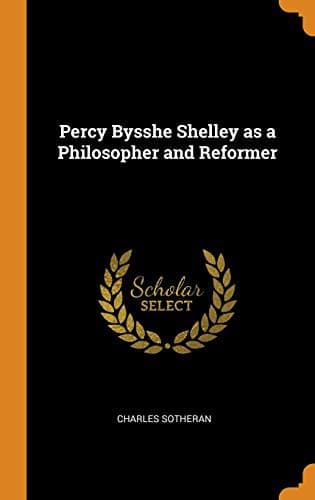
Percy Bysshe Shelley as a Philosopher and ReformerSotheran, Charles
Philosophy
Percy Bysshe Shelley as a Philosopher and Reformer
Sotheran, Charles
Shelley, Percy Bysshe, 1792-1822 -- Philosophy; Shelley, Percy Bysshe, 1792-1822 -- Political and social views
From such a soul-inspiring altar should praises like these be raised,
and with what sacred feeling would the pure worshipper revel "where
spirits live and dream--where all that is sweet in sound, or pure in
vision floats on the air, or passes dimly before the sight," for as
the late Professor J.G. Hoyt, in his essay on Shelley beautifully
points out--"To him everything was God, and God was everything. Every
place was peopled with forms of beauty and animated with living
intelligences. Hills and valleys, forests and fountains, were each
thronged with presiding deities--bright effluences from the Diving
that stirred within, and shone above the whole."
In leaving the first portion of my paper, I will make the following
quotation from a remarkable article on Shelley in the pages of the
_National Magazine_, which all minds unshackled, and free from
prejudice, must acknowledge to be correct in the main, and which
admirably sums up his efforts in metaphysical philosophy. Our
attention is called to the fact that we discover in all Shelley's
writings "a freer and purer development of what is best and noblest in
ourselves. We are taught in it to love all living and lifeless things,
with which in the material and moral universe we are surrounded--we
are taught to love the wisdom and goodness and majesty of the
Almighty, for we are taught to love the universe, his symbol and
visible exponent. God has given two books for the study and
instruction of mankind; the book of revelation and the book of nature.
In one at least of these was Shelley deeply versed, and in this one he
has given admirable lessons to his fellow-men. Throughout his
writings, every thought and every feeling is subdued and chastened by
a spirit of unutterable and boundless love. The poet meets us on the
common ground of a disinterested humanity, and he teaches us to hold
an earnest faith in the worth and the intrinsic Godliness of the soul.
He tells us--he makes us feel that there is nothing higher than human
hope, nothing deeper than the human heart; he exhorts us to labor
devotedly in the great and good work of the advancement of human
virtue and happiness, and stimulates us
"To love and hear--to hope till hope creates
From its own wreck the thing it contemplates."
It is observed by Shelley that
"The exertions of Locke, Hume, Gibbon, Voltaire, Rousseau,
and their disciples in favor of oppressed and deluded
humanity, are entitled to the gratitude of mankind. Yet it
is easy to calculate the degree of moral and intellectual
improvement which the world would have exhibited, had they
never lived. A little more nonsense would have been talked
for a century or two; and perhaps a few more men, women and
children burnt as heretics. We might not at this moment have
been congratulating each other on the abolition of the
Inquisition in Spain."
Public-domain text, read in full here on John Shaqi.
Reviews
Reviews
No reviews yet
Be the first to share your thoughts on this work.
Join the Discussion
Join the discussion
Sign in to leave a comment or review.
Sign InorCreate an account