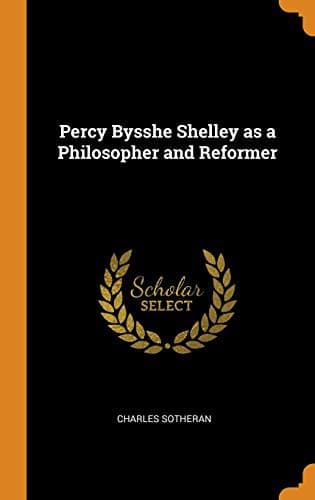
Percy Bysshe Shelley as a Philosopher and Reformer — John Shaqi
Percy Bysshe Shelley as a Philosopher and ReformerSotheran, Charles
Philosophy
Percy Bysshe Shelley as a Philosopher and Reformer
Sotheran, Charles
Shelley, Percy Bysshe, 1792-1822 -- Philosophy; Shelley, Percy Bysshe, 1792-1822 -- Political and social views
"Seraph of heaven! too gentle to be human,
Veiling beneath the radiant form of woman
All that is unsupportable in thee,
Of light, and love, and immortality."
I now approach a very delicate portion of my essay: the question of
the marriage relation. By many it is scouted with much virtuous
indignation, but I conceive that the liberal, who, like too many, dare
not discuss this matter in its broadest and widest aspects, should be
stigmatized as unworthy of the name. Christ is reported to have urged
the admirers of his ethical system to take up their cross and follow
him, leaving father, mother, wife, children, and all they may
have--thus Shelley acted, and it bears as equally pregnant lessons to
free thinkers as it did to those Syrian fishermen. Oh, that liberals
had as much "faith" in the truth, in the efficacy of their cause, as
the first Christians are said to have had in the teachings of that
Christ whom they regarded not as a Divinity, but as a son of God, as
we to-day are sons of God, of the most high! Oh, that we could carry
that "faith" into our beliefs, and the determination to be stopped at
no obstacle which may bar the progress of truth, which must conquer in
the end!
The favorite theme in the writings of Shelley is "Eros," love of the
individual, of the race, of nature, and in this he follows Christ, in
whose system of Philosophy, Love is ever the pre-dominating idea which
permeates mankind with its beneficial effects, and will, when the
bastard tinsel with which the truths of the Nazarene are hidden, be
replaced by that pure gold which it is impossible to trace in the
enunciations of any previous philosopher. This subject is always
present to Shelley, and he thus appeals in one of his poems to the
"Great Spirit, deepest Love!
Which rulest and dost move
All things which live, and are."
In another place he inquires--
"What is love? Ask him who lives, what is life? Ask him who
adores, what is God?"
And in the same essay he describes love as
"The bond and sanction which connects man with man, and with
everything which exists."
Elsewhere he points out that the attainment of love
"urges forth the power of man to arrest the faintest shadow
of that without the possession of which there is no rest nor
respite to the heart over which it rules, (and that) so soon
as this want or power is dead, man becomes the living
sepulchre of himself, and what yet survives is the mere husk
of what once he was."
Public-domain text, read in full here on John Shaqi.
Reviews
Reviews
No reviews yet
Be the first to share your thoughts on this work.
Join the Discussion
Join the discussion
Sign in to leave a comment or review.
Sign InorCreate an account