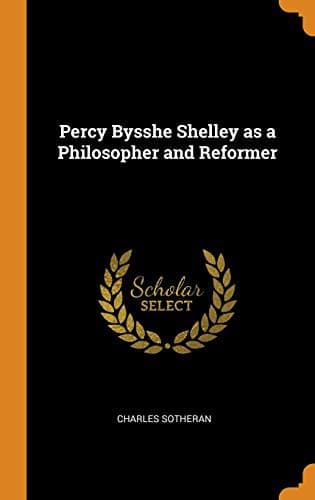
Percy Bysshe Shelley as a Philosopher and ReformerSotheran, Charles
Philosophy
Percy Bysshe Shelley as a Philosopher and Reformer
Sotheran, Charles
Shelley, Percy Bysshe, 1792-1822 -- Philosophy; Shelley, Percy Bysshe, 1792-1822 -- Political and social views
"Whosoever is free from the contamination of luxury and
license may go forth to the fields and to the woods,
inhaling joyous renovation from the breath of Spring, and
catching from the odors and sounds of autumn some diviner
mood of sweetest sadness, which improves the softened heart.
Whosoever is no deceiver and destroyer of his fellow-men--no
liar, no flatterer, no murderer--may walk among his species,
deriving, from the communion with all which they contain of
beautiful or majestic, some intercourse with the Universal
God. Whosoever has maintained with his own heart the
strictest correspondence of confidence, who dares to examine
and to estimate every imagination which suggests itself to
his mind--whosoever is that which he designs to _become_,
and only aspires to that which the divinity of his own
nature shall consider and approve--he has already seen God."
Can any one cavil with these beautiful expressions, this outpouring of
genius? If such there be, his heart and understanding must be sadly
warped, any appeal would be in vain, for him the Veil of Isis could
never be lifted. After a careful study of Shelley's works I can find
nothing to warrant the execration formerly levelled at his head, not
even in the "Refutation of Deism," that remarkable argument in the
Socratic style between Eusebes and Theosophus in which, as in all his
prose works, is displayed keen discernment, logical acuteness, and
close analytical reasoning not surpassed by the greatest
philosophers--most certainly his notions of God were not in unison
with the current theological ideas, and it was this daring rebellion
against the popular faith, the chief support of custom which caused
all the trouble. If ever he attempted to show the non-existence of
Deity, his negation was solely directed against the gross human
notions of a creative power, and _ergo_ a succession of finite
creative powers _ad infinitum_, or a Personal God who has only been
acknowledged in the popular teachings as an autocratic tyrant, and as
Shelley puts it in his own language:
"A venerable old man, seated on a throne of clouds, his
breast the theatre of various passions, analogous to those
of humanity, his will changeable and uncertain as that of an
earthly king."
Not to be compared with the far different eternal and infinite.
"Spirit of Nature! all sufficing power,
Necessity! thou mother of the world!
Unlike the God of human error, thou
Requirest no prayers or praises, the caprice
Of man's weak will belongs no more to thee
Than do the changeful passions of his breast
To thy unvarying harmony."
And by this doctrine of necessity here apostrophised our philosopher
instructs us in a lengthy statement of great clearness:
Public-domain text, read in full here on John Shaqi.
Reviews
Reviews
No reviews yet
Be the first to share your thoughts on this work.
Join the Discussion
Join the discussion
Sign in to leave a comment or review.
Sign InorCreate an account