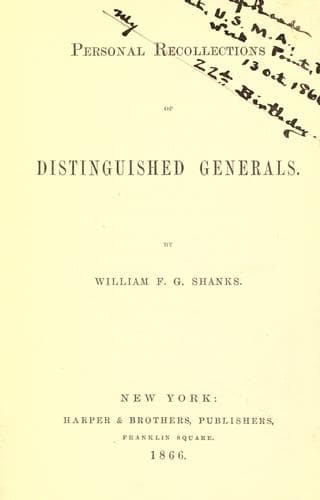
Personal Recollections of Distinguished GeneralsShanks, William Franklin Gore
History
Personal Recollections of Distinguished Generals
Shanks, William Franklin Gore
Generals -- United States; United States -- History -- Civil War, 1861-1865 -- Biography
From the time that loyal recruiting began, the issue between unionism
and secession became direct, and neutrality was practically a dead
letter. The mask of the rebels was stripped off, and the people were
no longer deceived by the schemes of the secessionists. Throughout
Kentucky, and particularly in Louisville, where the issue was
most saliently presented, singular scenes were the result of the
situation; and from this time until the occupation of the state by
the contending armies, Louisville was in a curious condition. Rebel
and Union recruiting stations were found in the same streets, and
presenting the same appearance, save that the rebels dared not plant
their flag, and displayed only that of Kentucky. Squads of Union and
rebel recruits daily passed each other on the streets _en route_ to
their camps, and saluted each other with groans, and hisses, and
ridicule, but attempted no violence. Day was made noisy with the
huzzas of the rebels "for Jeff. Davis and the Confederacy," and night
made hideous by rebel songs from rebel throats that had not the lame
excuse of being husky with liquor. Many of their songs were set to
very beautiful airs, and often large crowds of enthusiastic young men
would gather in the principal drinking saloons of the city and join
in these choruses, producing a very beautiful melody, but uttering
devilish poor sentiments. Frequently these songs were inspired by the
appearance of some well-known Union man, around whom they would gather,
like the witches in Macbeth, and at whom they sung their songs as if in
defiance. These scenes and songs often led to dangerous encounters and
riotous proceedings. The division of sentiment created by this state of
affairs entered into families, and extended even to the congregations
of churches. I remember one sad instance, in the family of Col. Henry
Clay, son of the sage of Ashland, and the one who fell so gloriously
at Buena Vista. In 1861, his two sons, Thomas and Henry Clay, were
living at Louisville. One of them, Thomas, became fascinated with the
manner and imbued with the ideas of Buckner, and followed him to the
Confederacy, and, as it happened, to ruin and to the grave. Henry, the
younger brother, a more thoughtful, quiet young man, less enthusiastic,
but more persistent than Thomas, joined the Union army, and served,
until his early death, on the staff of Gen. Richard W. Johnson. One of
the most amusing instances of the effects produced by the prevailing
sentiments occurred in one of the churches at Louisville, where, on
the occasion of a prayer-meeting, a notorious secessionist and a
prominent Union man had what was called at the time "a praying match."
During the prayer-meeting the minister asked the secession brother
to pray, which he did, asking, among other things, the "removal of
our evil rulers." He did not explain whom he meant by "evil rulers,"
but the congregation knew; so, not waiting to be called on, the Union
Public-domain text, read in full here on John Shaqi.
Reviews
Reviews
No reviews yet
Be the first to share your thoughts on this work.
Elsewhere in the archive
Join the Discussion
Join the discussion
Sign in to leave a comment or review.
Sign InorCreate an account