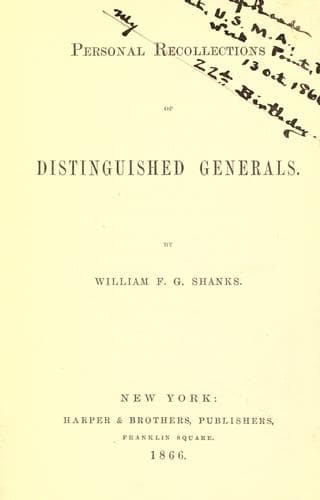
Personal Recollections of Distinguished GeneralsShanks, William Franklin Gore
History
Personal Recollections of Distinguished Generals
Shanks, William Franklin Gore
Generals -- United States; United States -- History -- Civil War, 1861-1865 -- Biography
McPherson was a Moreau, alike young, indecisive, and unfortunate.
True, we have developed many Grouchys, who can not command above a few
thousand men, and several Berthiers, who can not even calculate a day's
march correctly; but we have also given opportunity to one or two Neys
in Sheridan and Rousseau, and several Murats in Hancock, Logan, and
Gordon Granger.
But not less worthy of the cause have been the men who fought in the
ranks of our armies, and still more worthy to be compared to the best
armies of Europe than are our generals to be paralleled with the great
leaders of Europe. The superiors of our veterans never witnessed
battle. They form, as combined in armies, a study not less enticing and
interesting than that of the characters of their leaders.
One of the many fallacies which have been dissipated by our late
warlike experience is the idea which once prevailed that an uneducated
man made as good, if not a better soldier than the educated man.
When the late war began, it was an assertion made as positively as
frequently. It was believed, particularly by the regular officers, that
the persons of the former class more readily and completely adapted
themselves to the discipline of the camps--more readily became the
pliant and obedient tools that regular soldiers are too often made. It
is to the veteran volunteers of the late war for the Union that we are
indebted for the explosion of this fallacy. The proofs of its falsity
are not less interesting than conclusive.
Every reader familiar with the history of modern warfare in Europe
must have noticed, in watching the events of the late rebellion in
this country, the very great difference between the practice of war as
carried on in Europe and by ourselves. The rules have been the same;
the theory of war is too firmly and philosophically established to be
changed. It can not be said that we originated a single new rule, but
our application of those long established has been unlike any other
practice known to history. The extent of the field of operations, the
peculiar configuration of the country, and the extended line of coast
and inland frontier which each party to the contest had to guard,
conspired to this end, and caused to be originated such peculiarities
of warfare as long and arduous raids by entire armies, flank marches
of an extent and boldness never before conceived, the construction
of many leagues of fortified lines, and the execution of strategic
marches of great originality and brilliancy, while there have been
effected at the same time, owing to changes and improvements in the
arms, several innovations in minor tactics not less curious than
important. The contending parties fought dozens of battles, each of
which would have been decisive of a war between any two of the great
powers of Europe. There the limits of the field of operations are
restricted by the presence of armed neutral powers on each frontier.
Here the line of frontier extended across a whole continent. No
Public-domain text, read in full here on John Shaqi.
Reviews
Reviews
No reviews yet
Be the first to share your thoughts on this work.
Elsewhere in the archive
Join the Discussion
Join the discussion
Sign in to leave a comment or review.
Sign InorCreate an account