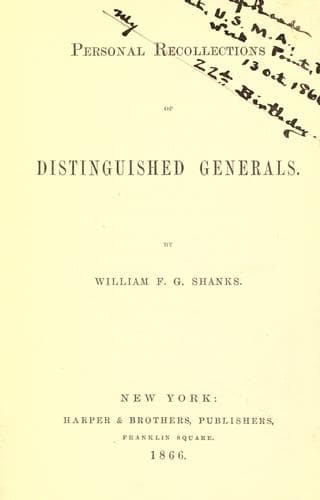
Personal Recollections of Distinguished GeneralsShanks, William Franklin Gore
History
Personal Recollections of Distinguished Generals
Shanks, William Franklin Gore
Generals -- United States; United States -- History -- Civil War, 1861-1865 -- Biography
necessities exist there, as here, for large numbers of large armies.
The most important and extensive modern European wars witnessed the
prosecution of only one important operation at a time, while in this
country we have carried on several campaigns simultaneously, and fought
pitched battles whose tactical as well as strategic success depended
on the result of operations five hundred miles distant. Bragg won the
victory of Chickamauga only by the aid of re-enforcements sent him
from Richmond; the besieged army of Rosecrans at Chattanooga was saved
from dispersion only by the timely re-enforcements sent him, under
Hooker, from Washington; while Schofield, with twenty thousand men,
after fighting at Nashville, Tennessee, in the middle of winter, was
operating in North Carolina, opening communications with Sherman, a
fortnight subsequently. In Europe, concentration is forced on each
party by the configuration and confined area of the seat of war. In
this country the opposite effect has naturally been the result of the
opposite circumstances, and the finest display of generalship which
we have had was shown by Grant in the consummate skill with which, in
the latter year of the war, he concentrated our two greatest armies,
and employed his cavalry against the vital point of the rebellion,
while with the fractional organizations he kept the enemy employed in
the far West. Generally speaking, any two European powers at war are
represented each by a single army, which are brought together upon a
field of battle to decide at a blow the question in dispute, and thus
the European generals are afforded better chances for the display of
tactical abilities. In Europe, cavalry plays an important part on
every battle-field, while in this country its assistance has seldom
been asked in actual battle, though a no less effective application
has been made of it in destroying communications. Except in the battle
of General Sheridan, and in some instances where accident has brought
cavalry into battle, our troopers were never legitimately employed.
The art of marching as practiced in Europe was also varied here, and
the European system of supplying an army is very different from our
own. Their lines of march are decided by the necessities for providing
cantonments in the numerous villages of the country, while on this
continent marches are retarded, if not controlled, by the necessity of
carrying tents for camps. The parallel which is here merely outlined
might be pursued by one better fitted for the task to a highly
suggestive and interesting conclusion.
Public-domain text, read in full here on John Shaqi.
Reviews
Reviews
No reviews yet
Be the first to share your thoughts on this work.
Elsewhere in the archive
Join the Discussion
Join the discussion
Sign in to leave a comment or review.
Sign InorCreate an account