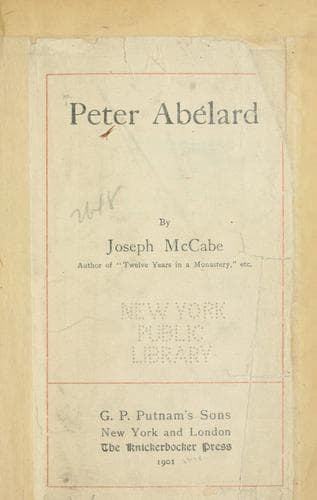
Abelard, Peter, 1079-1142; Theologians -- France -- Biography; Theology -- History -- Middle Ages, 600-1500
It was far otherwise with the spirit of Abélard, the fundamental
principle or maxim on which all else depended. The thirteenth
century cordially accepted that principle, and applied itself to the
rationalisation of theology. It wholly abandoned the mysticism of
Bernard and the school of St. Victor. The Cistercian had summed up
Abélard’s misdeeds thus in his letter to the pope: ‘He peers into
the heavens and searches the hidden things of God, then, returning
to us, he holds discourse on ineffable things of which a man may
not speak.’ In the very sense in which this was said of Abélard, it
may be urged as a chief characteristic of the saintly schoolmen of
the thirteenth century. Even St. Bonaventure was no mystic in the
anti-rational sense of Bernard; simply, he applied to theology the
reason of Plato instead of the reason of Aristotle. Archbishop Roger
Vaughan, in his _Life of St. Thomas_, says that the schoolmen owed
the ‘_probatur ratione_’ in their _loci theologici_ to Abélard. That
is already a most striking vindication of Abélard’s characteristic
teaching as to the function of reason, for we know how important
the ‘proofs from reason’ were in the scheme of Aquinas and Scotus.
But they really owe far more than this to Abélard. If they have
deserted the dreamy, rambling, fruitless, and fantastic speculation
of the mystic school for a methodical and syllogistic inquiry
concerning each point of faith, it is largely due to the example of
Abélard. The schoolmen notoriously followed Peter the Lombard. From
the _Sentences_ of Peter the Lombard to the _Sic et Non_ of Peter
Abélard—through such works as the _Sentences_ of Roland and Omnebene
of Bologna and the so-called _Sentences of Peter Abélard_—is a short
and easy journey. No doubt we must not lose sight of that other
event which so powerfully influenced the theology of the thirteenth
century: the invasion of the Arab and Jew philosophers. Theirs is the
only influence of which the schoolmen show any consciousness in their
elaborate fortification of dogma to meet the criticism of reason and
conscience—except for the avowed influence of the Lombard; and along
that line we may trace the direct influence of Abélard.
Public-domain text, read in full here on John Shaqi.
Reviews
Reviews
No reviews yet
Be the first to share your thoughts on this work.
Elsewhere in the archive
Join the Discussion
Join the discussion
Sign in to leave a comment or review.
Sign InorCreate an account