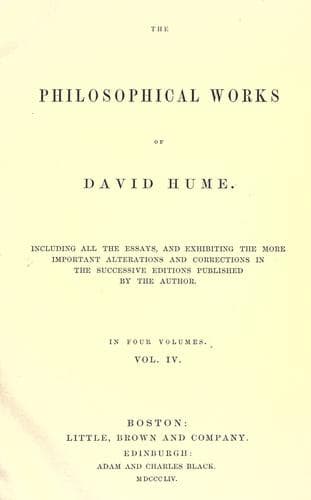
Philosophical Works, v. 1 (of 4): Including All the Essays, and Exhibiting the More Important Alterations and Corrections in the Successive Editions Published by the AuthorHume, David
PhilosophyPhilosophy
Philosophical Works, v. 1 (of 4): Including All the Essays, and Exhibiting the More Important Alterations and Corrections in the Successive Editions Published by the Author
Hume, David
Knowledge, Theory of; Philosophy, English -- 18th century
These consequences we may carry one step farther, and conclude that all
the pretended demonstrations for the infinite divisibility of extension
are equally sophistical; since 'tis certain these demonstrations cannot
be just without proving the impossibility of mathematical points; which
'tis an evident absurdity to pretend to.
[1] It has been objected to me, that infinite divisibility supposes
only an infinite number of _proportional_ not of _aliquot_ parts, and
that an infinite number of proportional parts does not form an infinite
extension. But this distinction is entirely frivolous. Whether these
parts be called _aliquot_ or _proportional_, they cannot be inferior
to those minute parts we conceive; and therefore, cannot form a less
extension by their conjunction.
[2] Mons. Malezieu.
SECTION III.
OF THE OTHER QUALITIES OF OUR IDEAS OF SPACE AND TIME.
No discovery could have been made more happily for deciding all
controversies concerning ideas, than that above mentioned, that
impressions always take the precedency of them, and that every idea,
with which the imagination is furnished, first makes its appearance in
a correspondent impression. These latter perceptions are all so clear
and evident, that they admit of no controversy; though many of our
ideas are so obscure, that 'tis almost impossible even for the mind,
which forms them, to tell exactly their nature and composition. Let us
apply this principle, in order to discover farther the nature of our
ideas of space and time.
Upon opening my eyes and turning them to the surrounding objects,
I perceive many visible bodies; and upon shutting them again, and
considering the distance betwixt these bodies, I acquire the idea
of extension. As every idea is derived from some impression which
is exactly similar to it, the impressions similar to this idea of
extension, must either be some sensations derived from the sight, or
some internal impressions arising from these sensations.
Our internal impressions are our passions, emotions, desires, and
aversions; none of which, I believe, will ever be asserted to be
the model from which the idea of space is derived. There remains,
therefore, nothing but the senses which can convey to us this original
impression. Now, what impression do our senses here convey to us? This
is the principal question, and decides without appeal concerning the
nature of the idea.
The table before me is alone sufficient by its view to give me the
idea of extension. This idea, then, is borrowed from, and represents
some impression which this moment appears to the senses. But my senses
convey to me only the impressions of coloured points, disposed in a
certain manner. If the eye is sensible of any thing farther, I desire
it may be pointed out to me. But, if it be impossible to shew any thing
farther, we may conclude with certainty, that the idea of extension is
nothing but a copy of these coloured points, and of the manner of their
appearance.
Public-domain text, read in full here on John Shaqi.
Reviews
Reviews
No reviews yet
Be the first to share your thoughts on this work.
Elsewhere in the archive
Join the Discussion
Join the discussion
Sign in to leave a comment or review.
Sign InorCreate an account