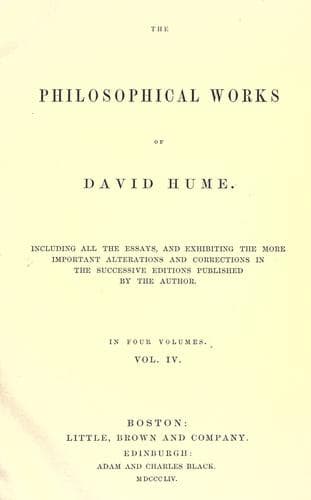
Philosophical Works, v. 1 (of 4): Including All the Essays, and Exhibiting the More Important Alterations and Corrections in the Successive Editions Published by the AuthorHume, David
PhilosophyPhilosophy
Philosophical Works, v. 1 (of 4): Including All the Essays, and Exhibiting the More Important Alterations and Corrections in the Successive Editions Published by the Author
Hume, David
Knowledge, Theory of; Philosophy, English -- 18th century
Suppose that, in the extended object, or composition of coloured
points, from which we first received the idea of extension, the points
were of a purple colour; it follows, that in every repetition of that
idea we would not only place the points in the same order with respect
to each other, but also bestow on them that precise colour with which
alone we are acquainted. But afterwards, having experience of the other
colours of violet, green, red, white, black, and of all the different
compositions of these, and finding a resemblance in the disposition of
coloured points, of which they are composed, we omit the peculiarities
of colour, as far as possible, and found an abstract idea merely on
that disposition of points, or manner of appearance, in which they
agree. Nay, even when the resemblance is carried beyond the objects
of one sense, and the impressions of touch are found to be similar
to those of sight in the disposition of their parts; this does not
hinder the abstract idea from representing both, upon account of their
resemblance. All abstract ideas are really nothing but particular ones,
considered in a certain light; but being annexed to general terms, they
are able to represent a vast variety, and to comprehend objects, which,
as they are alike in some particulars, are in others vastly wide of
each other.
The idea of time, being derived from the succession of our perceptions
of every kind, ideas as well as impressions, and impressions of
reflection as well as of sensation, will afford us an instance of an
abstract idea, which comprehends a still greater variety than that
of space, and yet is represented in the fancy by some particular
individual idea of a determined quantity and quality.
Public-domain text, read in full here on John Shaqi.
Reviews
Reviews
No reviews yet
Be the first to share your thoughts on this work.
Elsewhere in the archive
Join the Discussion
Join the discussion
Sign in to leave a comment or review.
Sign InorCreate an account