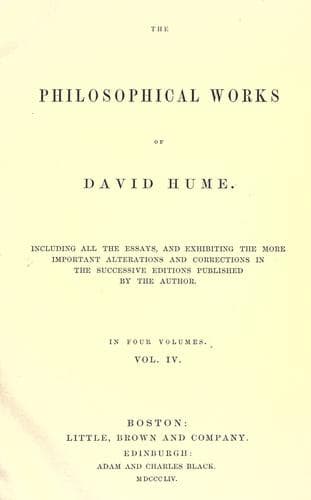
Philosophical Works, v. 1 (of 4): Including All the Essays, and Exhibiting the More Important Alterations and Corrections in the Successive Editions Published by the AuthorHume, David
PhilosophyPhilosophy
Philosophical Works, v. 1 (of 4): Including All the Essays, and Exhibiting the More Important Alterations and Corrections in the Successive Editions Published by the Author
Hume, David
Knowledge, Theory of; Philosophy, English -- 18th century
As 'tis from the disposition of visible and tangible objects we receive
the idea of space, so, from the succession of ideas and impressions we
form the idea of time; nor is it possible for time alone ever to make
its appearance, or be taken notice of by the mind. A man in a sound
sleep, or strongly occupied with one thought, is insensible of time;
and according as his perceptions succeed each other with greater or
less rapidity, the same duration appears longer or shorter to his
imagination. It has been remarked by a great philosopher,[3] that our
perceptions have certain bounds in this particular, which are fixed by
the original nature and constitution of the mind, and beyond which no
influence of external objects on the senses is ever able to hasten or
retard our thought. If you wheel about a burning coal with rapidity,
it will present to the senses an image of a circle of fire; nor will
there seem to be any interval of time betwixt its revolutions; merely
because 'tis impossible for our perceptions to succeed each other,
with the same rapidity that motion may be communicated to external
objects. Wherever we have no successive perceptions, we have no notion
of time, even though there be a real succession in the objects. From
these phenomena, as well as from many others, we may conclude, that
time cannot make its appearance to the mind, either alone or attended
with a steady unchangeable object, but is always discovered by some
_perceivable_ succession of changeable objects.
To confirm this we may add the following argument, which to me seems
perfectly decisive and convincing. 'Tis evident, that time or duration
consists of different parts: for otherwise, we could not conceive a
longer or shorter duration. 'Tis also evident, that these parts are
not co-existent: for that quality of the coexistence of parts belongs
to extension, and is what distinguishes it from duration. Now as time
is composed of parts that are not co-existent, an unchangeable object,
since it produces none but co-existent impressions, produces none that
can give us the idea of time; and, consequently, that idea must be
derived from a succession of changeable objects, and time in its first
appearance can never be severed from such a succession.
Having therefore found, that time in its first appearance to the mind
is always conjoined with a succession of changeable objects, and that
otherwise it can never fall under our notice, we must now examine,
whether it can be _conceived_ without our conceiving any succession
of objects, and whether it can alone form a distinct idea in the
imagination.
Public-domain text, read in full here on John Shaqi.
Reviews
Reviews
No reviews yet
Be the first to share your thoughts on this work.
Elsewhere in the archive
Join the Discussion
Join the discussion
Sign in to leave a comment or review.
Sign InorCreate an account