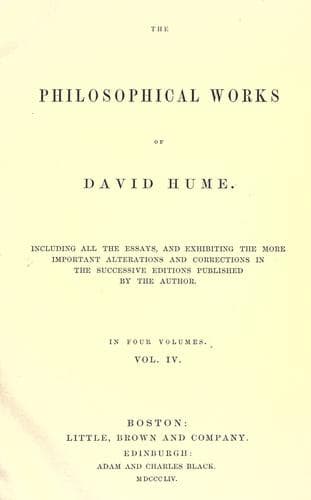
Philosophical Works, v. 1 (of 4): Including All the Essays, and Exhibiting the More Important Alterations and Corrections in the Successive Editions Published by the AuthorHume, David
PhilosophyPhilosophy
Philosophical Works, v. 1 (of 4): Including All the Essays, and Exhibiting the More Important Alterations and Corrections in the Successive Editions Published by the Author
Hume, David
Knowledge, Theory of; Philosophy, English -- 18th century
In order to know whether any objects, which are joined in impression,
be separable in idea, we need only consider if they be different from
each other; in which case, 'tis plain they may be conceived apart.
Every thing that is different is distinguishable, and every thing
that is distinguishable may be separated, according to the maxims
above explained. If, on the contrary, they be not different, they are
not distinguishable; and if they be not distinguishable, they cannot
be separated. But this is precisely the case with respect to time,
compared with our successive perceptions. The idea of time is not
derived from a particular impression mixed up with others, and plainly
distinguishable from them, but arises altogether from the manner in
which impressions appear to the mind, without making one of the number.
Five notes played on a flute give us the impression and idea of time,
though time be not a sixth impression which presents itself to the
hearing or any other of the senses. Nor is it a sixth impression which
the mind by reflection finds in itself. These five sounds making their
appearance in this particular manner, excite no emotion in the mind,
nor produce an affection of any kind, which being observed by it can
give rise to a new idea. For _that_ is necessary to produce a new idea
of reflection; nor can the mind, by revolving over a thousand times
all its ideas of sensation, ever extract from them any new original
idea, unless nature has so framed its faculties, that it feels some
new original impression arise from such a contemplation. But here it
only takes notice of the our the _manner_ in which the different sounds
make their appearance, and that it may afterwards consider without
considering these particular sounds, but may conjoin it with any other
objects. The ideas of some objects it certainly must have, nor is it
possible for it without these ideas ever to arrive at any conception of
time; which, since it appears not as any primary distinct impression,
can plainly be nothing but different ideas, or impressions, or objects
disposed in a certain manner, that is, succeeding each other.
Public-domain text, read in full here on John Shaqi.
Reviews
Reviews
No reviews yet
Be the first to share your thoughts on this work.
Elsewhere in the archive
Join the Discussion
Join the discussion
Sign in to leave a comment or review.
Sign InorCreate an account