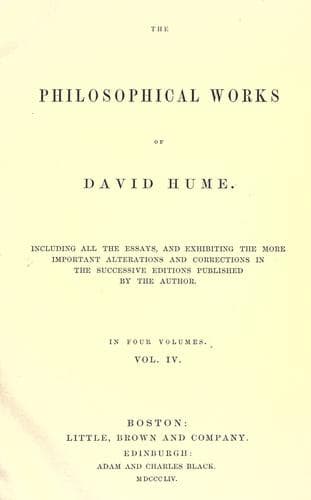
Philosophical Works, v. 1 (of 4): Including All the Essays, and Exhibiting the More Important Alterations and Corrections in the Successive Editions Published by the AuthorHume, David
PhilosophyPhilosophy
Philosophical Works, v. 1 (of 4): Including All the Essays, and Exhibiting the More Important Alterations and Corrections in the Successive Editions Published by the Author
Hume, David
Knowledge, Theory of; Philosophy, English -- 18th century
But why need we seek for other arguments to prove, that a present
impression with a relation or transition of the fancy may enliven any
idea, when this very instance of our reasonings from cause and effect
will alone suffice to that purpose? 'Tis certain we must have an idea
of every matter of fact which we believe. 'Tis certain that this idea
arises only from a relation to a present impression. 'Tis certain that
the belief superadds nothing to the idea, but only changes our manner
of conceiving it, and renders it more strong and lively. The present
conclusion concerning the influence of relation is the immediate
consequence of all these steps; and every step appears to me sure and
infallible. There enters nothing into this operation of the mind but
a present impression, a lively idea, and a relation or association in
the fancy betwixt the impression and idea; so that there can be no
suspicion of mistake.
In order to put this whole affair in a fuller light, let us consider
it as a question in natural philosophy, which we must determine by
experience and observation. I suppose there is an object presented,
from which I draw a certain conclusion, and form to myself ideas, which
I am said to believe or assent to. Here 'tis evident, that however that
object, which is present to my senses, and that other, whose existence
I infer by reasoning, may be thought to influence each other by their
particular powers or qualities; yet as the phenomenon of belief, which
we at present examine, is merely internal, these powers and qualities
being entirely unknown, can have no hand in producing it. 'Tis the
present impression which is to be considered as the true and real cause
of the idea, and of the belief which attends it. We must therefore
endeavour to discover, by experiments, the particular qualities by
which 'tis enabled to produce so extraordinary an effect.
First then I observe, that the present impression has not this effect
by its own proper power and efficacy, and, when considered alone
as a single perception, limited to the present moment. I find that
an impression, from which, on its first appearance, I can draw no
conclusion, may afterwards become the foundation of belief, when I have
had experience of its usual consequences. We must in every case have
observed the same impression in past instances, and have found it to
be constantly conjoined with some other impression. This is confirmed
by such a multitude of experiments, that it admits not of the smallest
doubt.
Public-domain text, read in full here on John Shaqi.
Reviews
Reviews
No reviews yet
Be the first to share your thoughts on this work.
Elsewhere in the archive
Join the Discussion
Join the discussion
Sign in to leave a comment or review.
Sign InorCreate an account