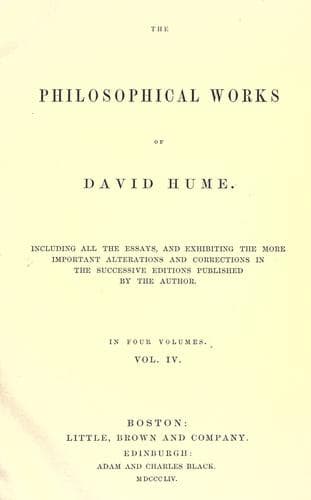
Philosophical Works, v. 1 (of 4): Including All the Essays, and Exhibiting the More Important Alterations and Corrections in the Successive Editions Published by the AuthorHume, David
PhilosophyPhilosophy
Philosophical Works, v. 1 (of 4): Including All the Essays, and Exhibiting the More Important Alterations and Corrections in the Successive Editions Published by the Author
Hume, David
Knowledge, Theory of; Philosophy, English -- 18th century
Suppose two objects to be presented to us, of which the one is the
cause and the other the effect; 'tis plain that, from the simple
consideration of one, or both these objects, we never shall perceive
the tie by which they are united, or be able certainly to pronounce,
that there is a connexion betwixt them. 'Tis not, therefore, from any
one instance, that we arrive at the idea of cause and effect, of a
necessary connexion of power, of force, of energy, and of efficacy.
Did we never see any but particular conjunctions of objects, entirely
different from each other, we should never be able to form any such
ideas.
But, again, suppose we observe several instances in which the same
objects are always conjoined together, we immediately conceive a
connexion betwixt them, and begin to draw an inference from one
to another. This multiplicity of resembling instances, therefore,
constitutes the very essence of power or connexion, and is the source
from which the idea of it arises. In order, then, to understand the
idea of power, we must consider that multiplicity; nor do I ask more
to give a solution of that difficulty, which has so long perplexed
us. For thus I reason. The repetition of perfectly similar instances
can never _alone_ give rise to an original idea, different from what
is to be found in any particular instance, as has been observed, and
as evidently follows from our fundamental principle, _that all ideas
are copied from impressions_. Since, therefore, the idea of power is
a new original idea, not to be found in any one instance, and which
yet arises from the repetition of several instances, it follows, that
the repetition _alone_ has not that effect, but must either _discover_
or _produce_ something new, which is the source of that idea. Did the
repetition neither discover nor produce any thing new, our ideas might
be multiplied by it, but would not be enlarged above what they are upon
the observation of one single instance. Every enlargement, therefore,
(such as the idea of power or connexion) which arises from the
multiplicity of similar instances, is copied from some effects of the
multiplicity, and will be perfectly understood by understanding these
effects. Wherever we find any thing new to be discovered or produced by
the repetition, there we must place the power, and must never look for
it in any other object.
Public-domain text, read in full here on John Shaqi.
Reviews
Reviews
No reviews yet
Be the first to share your thoughts on this work.
Elsewhere in the archive
Join the Discussion
Join the discussion
Sign in to leave a comment or review.
Sign InorCreate an account